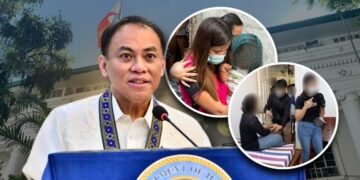



The Philippine Center for Investigative Journalism (PCIJ) wrongly claimed in its report “Pork Accounts for Two-Thirds of Proposed 2026 DPWH Budget” that House leaders inserted pork-style funds into the 2026 DPWH budget for their districts, highlighting large increases including for Speaker Faustino “Bojie” Dy III.
No such insertions happened, and the alleged increases are legitimate amendments and errata rather than pork or illegal additions.
Pork barrel funds refer to discretionary lump-sum amounts that individual legislators fully control with minimal oversight, transparency, or competitive bidding, a system that enabled massive corruption through fake projects and kickbacks and prompted the Supreme Court to declare pork barrel unconstitutional and illegal in 2013.
Illegal insertions typically mean new projects or additional funds slipped in secretly after the main deliberations, either after the bill has passed the House or Senate or during traditionally closed-door bicameral conference committee meetings.
Nothing like that took place in the 2026 budget process, where all adjustments to district projects and allocations resulted from standard, legitimate institutional amendments and errata conducted openly during House deliberations, and these changes never increased the overall DPWH budget beyond the House-approved total of P624.48 billion – an amount already lower than earlier executive proposals after President Bongbong Marcos directed the complete removal of all locally funded flood control projects in response to a major corruption scandal involving substandard, incomplete, or nonexistent projects from prior years.
Institutional amendments allow lawmakers to realign funds between different projects within the same congressional district to better match local priorities without adding a single peso to the national total, while errata serve as official corrections or reprioritizations often required when higher authorities like the President direct the removal or transfer of certain items – for example, transferring P20 million originally earmarked for road construction in a specific barangay to instead build a health facility in the exact same barangay, keeping the money, location, and purpose targeted but adjusting the project type to address urgent needs.
The House thoroughly discussed, revised, and ratified all these items before passing the General Appropriations Bill on third reading, distributed the final version to every member of Congress, and made no alterations afterward.
The ongoing bicameral conference committee that started on December 14 and is being livestreamed publicly for the first time in history, limits its work to reconciling differences between the House version (P624.48 billion) and the Senate version (P570.48 billion) without introducing any new projects or funds.
The PCIJ report reached its conclusions by comparing initial DPWH submissions to the final House version without factoring in these required errata, amendments, and reprioritizations, which led it to mistake normal realignments for “insertions.”
For instance, Speaker Dy’s district saw its allocation rise from an initial P1.1 billion to P3.8 billion through these standard amendments, but the final figure aligns with allocations in many other districts across the country and reflects adjusted priorities rather than extra money.
In stark contrast to the previous leadership under former Speaker Martin Romualdez, where massive flood control allocations in the 2025 budget were tainted by allegations of secret insertions during closed-door bicameral conferences – enabling favored contractors to secure contracts for projects that turned out to be substandard, incomplete, or entirely ghost, resulting in billions in alleged kickbacks, widespread protests, resignations, and criminal investigations – the current process under Speaker Dy includes zero funding for local flood control projects, relies solely on open amendments and errata during deliberations, and benefits from historic public livestreaming of bicam proceedings to ensure no opaque last-minute changes occur.
The entire process has adhered strictly to post-2013 rules designed to prevent abuse, with unprecedented public access ensuring accountability and transparency.
Labeling every increase in infrastructure spending as an insertion may sound tough on corruption, but it comes at a real cost. It discourages much-needed investment in disaster-prone and infrastructure-poor areas and blurs the line between excess and genuine necessity. True budget oversight must be careful and precise. Treating all infrastructure allocations as inherently suspect does not properly inform the public and instead risks further eroding trust in a legislative institution already scarred by past abuses, even as legitimate efforts are underway to restore confidence through greater openness and accountability.