
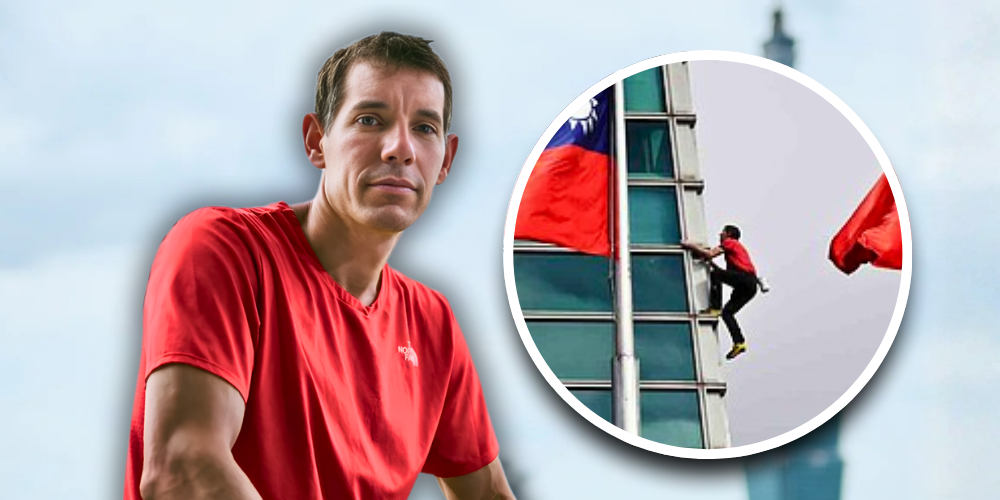
American climber Alex Honnold added another unprecedented feat to his career after completing a rope-free ascent of Taipei 101, one of the tallest skyscrapers in the world. The 508-meter tower in Taiwan’s capital was climbed without a harness, rope, or protective equipment, underscoring Honnold’s reputation as one of the most technically precise and mentally disciplined climbers of his generation.
Honnold finished the climb in one hour and 31 minutes, cutting the previous benchmark by more than half. His ascent surpassed the earlier effort by French climber Alain Robert, who scaled the building in four hours using ropes and a harness. The climb was initially scheduled a day earlier but was postponed due to wet conditions, highlighting the narrow safety margins involved in an unprotected ascent of a glass-and-steel structure.
Best known for redefining what is possible in climbing, Honnold rose to global prominence after becoming the first person to free solo El Capitan, a 915-meter granite wall in Yosemite National Park. That climb, completed without safety gear, reshaped perceptions of elite climbing and became the subject of the Academy Award-winning documentary Free Solo. The film documented not only the physical challenge but the intense preparation and psychological control required for such an ascent.
The Taipei 101 climb was streamed live by Netflix, which implemented a broadcast delay due to the inherent risks of the attempt. Despite wind, heat, and vocal crowds visible through the tower’s windows, Honnold maintained his pace, briefly acknowledging spectators near the 89th floor before continuing upward.
Taiwan Vice President Bi-khim Hsiao publicly congratulated Honnold after the climb, remarking on the difficulty of even watching the feat. At the summit, Honnold was met by his wife, marking the end of another high-risk, precisely executed ascent.
Over the course of his career, Honnold has become synonymous with free solo climbing, a discipline defined by absolute commitment and zero tolerance for error. His climb of Taipei 101 extends his legacy beyond natural rock faces into the urban skyline, reinforcing his standing as a climber who consistently operates at the outer limits of human performance.