

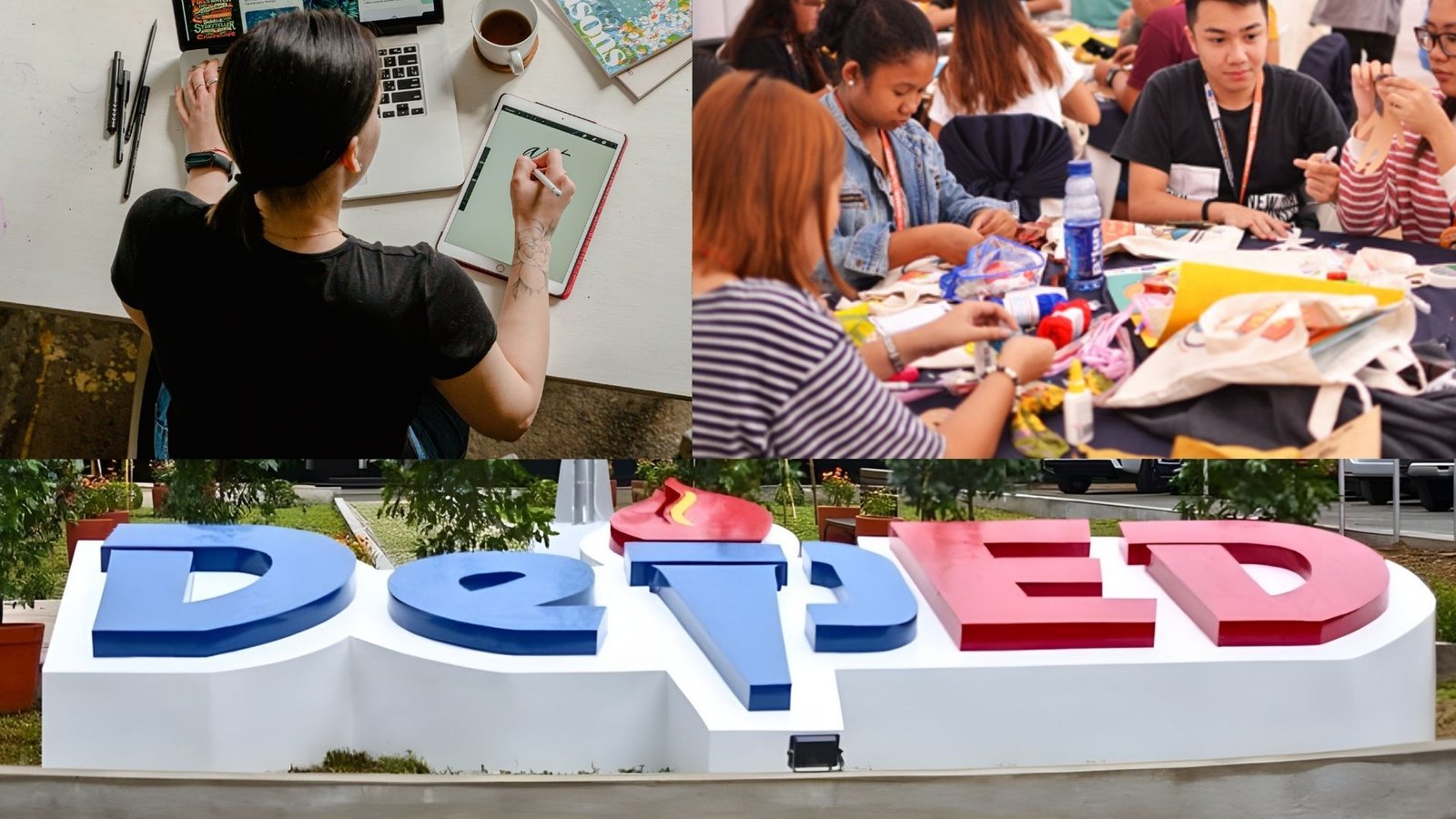
The DepEd is rolling out reforms in basic education aimed at expanding the country’s pool of creative and work-ready Filipinos, as the agency pushes to embed creativity and practical skills across the public school system from early grades through senior high school.
Speaking at the 3rd Creativity in Philippine Higher Education Summit in Batac City, Ilocos Norte on December 16, Education Secretary Sonny Angara said DepEd has recalibrated its priorities toward stronger foundational learning, earlier exposure to creative skills, and clearer pathways from basic education to college and employment.
The shift reflects a broader policy direction that treats creativity as a core competency rather than a supplemental activity. “This tells us that the imagination does not magically appear in adulthood. So in DepEd, we have deliberately shifted our focus toward stronger foundational learning, which is a strong thrust of the President,” Angara said.
Under the reforms, DepEd is strengthening the alignment of senior high school tracks with industry needs, particularly in creative and digital fields, while deepening collaboration with the private sector. The department is also tightening coordination with the Commission on Higher Education and the Technical Education and Skills Development Authority to reduce gaps between basic education, higher learning, and employment, with the goal of making school-to-work transitions more direct and practical.
Angara cited government data showing that the creative economy contributed more than ₱1.9 trillion to the Philippine economy in 2024, reinforcing the need to cultivate creative skills early within the public education system. He pointed to Ilocos Norte as an example of how education, culture, and local governance can translate into economic activity, citing initiatives such as Himala sa Buhangin, inabel weaving, burnay pottery, and regional festivals as proof that creative industries thrive beyond Metro Manila.
He also acknowledged the role of First Lady Liza Marcos in advancing arts and culture as part of national development, particularly through the expansion of national museums and cultural spaces in the regions, which complement classroom-based learning.
DepEd said the reforms are designed to produce graduates who can move directly into studios, design labs, production floors, and other creative workplaces, positioning creativity as a skill developed continuously from childhood through formal education. “With these programs aligned, we shape a developmental arc from childhood to higher education to industry, where creativity is refined, not restricted,” Angara said.