

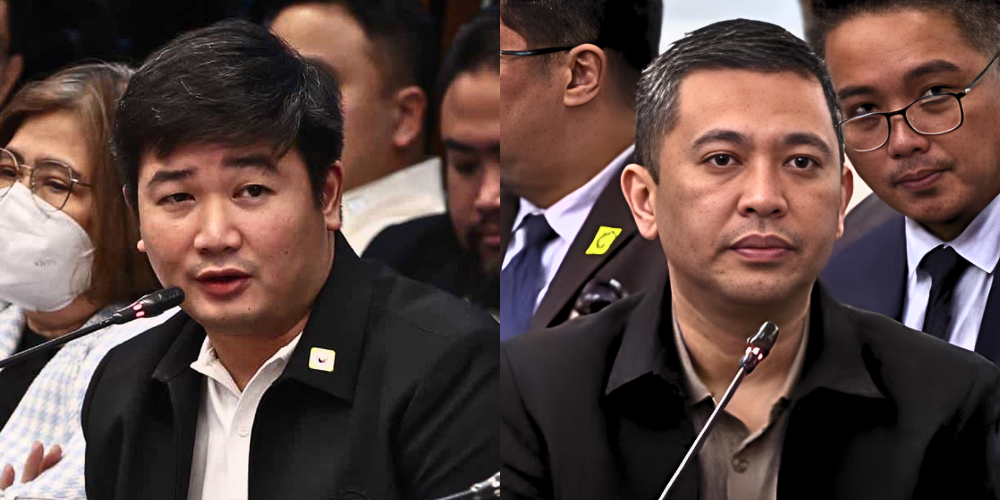
Former Department of Public Works and Highways engineers Brice Hernandez and Jaypee Mendoza have asked the Department of Justice to exclude several sworn statements from being used as evidence against them, including a whistleblower’s report that previously detailed the alleged modus operandi behind irregularities in flood control projects.
In counter-affidavits filed on January 5 in response to complaints for malversation, graft, and direct bribery lodged by the National Bureau of Investigation, Hernandez argued that at least three of the statements were executed as part of their application to the Witness Protection Program and should not have been admitted as evidence. He said their use violated his constitutional right against self-incrimination and provisions of the Witness Protection Act.
Hernandez and Mendoza are both facing preliminary investigation for their alleged involvement in a suspected ghost flood control project in Pandi, Bulacan. They have also been arraigned and are currently on trial before the Sandiganbayan in connection with another anomalous flood control project in the province, along with former senator Ramon Bong Revilla, Jr. and other accused. All are detained at the New Quezon City Jail. Their applications to become state witnesses were denied.
In his filing, Hernandez said the whistleblower report and related affidavits contained information that was critical to the government’s investigation into alleged flood control anomalies involving several high-profile public officials, but admitted that the same disclosures also implicated him in the transactions under scrutiny.
He claimed he was pressured into signing the affidavits late at night after a full day of questioning and without being given sufficient time to review or verify their contents. According to Hernandez, he and his counsel were handed the sworn statement around 10 p.m., after an interview that began early in the morning, and were told to sign and affix fingerprints as the office was about to close.
Hernandez further alleged that investigators assured him the statements would be used solely to support cases against other public officials and private individuals and in connection with his witness protection application. He said he later learned that the same statements were used as the basis for charges against him, which he claimed violated both the law and the terms under which the affidavits were executed.
He argued that without the whistleblower report, joint affidavit, and sworn statement, the complaints against him would lack factual foundation, as the charges were built primarily on the information contained in those documents. Mendoza similarly stated that the complaint relied heavily on their statements, as well as those of another DPWH official.
Hernandez maintained that under the law, affidavits submitted as part of an application to the Witness Protection Program cannot be admitted as evidence, except for impeachment purposes. His legal team confirmed the filing of the counter-affidavit but declined further comment, citing the ongoing investigation.
Acting Justice Secretary Fredderick Vida said the statements executed by Hernandez were useful in advancing the investigation but stressed that the government’s case is not dependent on a single source and that other witnesses continue to cooperate.
Vida also cautioned against reversing sworn declarations, noting the legal consequences involved.
“Hindi biro-biro yung magbaliktad ng statement diba? kasi sworn statement yan may kinakaharap kang mga consequences,” he said.