

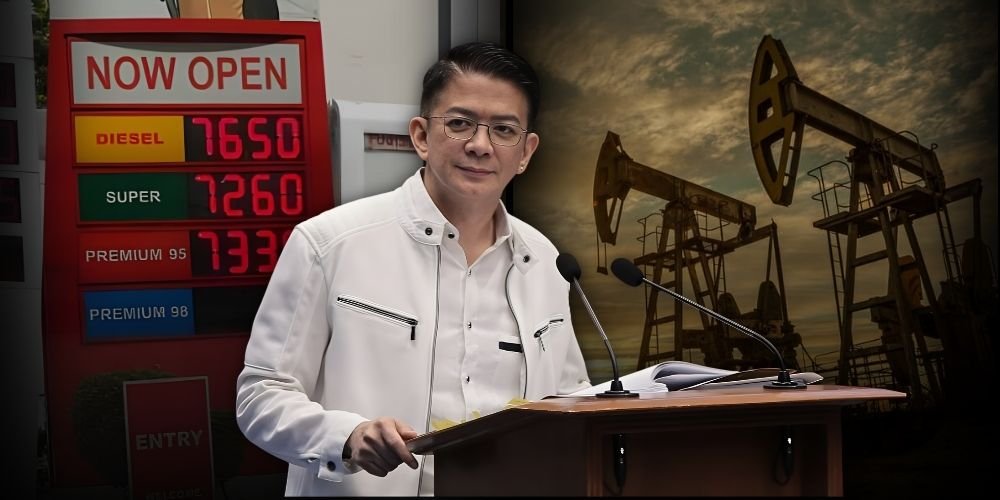
Former Senate President Chiz Escudero has filed a bill that would allow the President to temporarily suspend or reduce taxes on petroleum products when global oil prices rise due to supply disruptions or geopolitical crises.
Filed on March 9, Senate Bill No. 1938 seeks to authorize the President to reduce excise taxes and value-added taxes on petroleum products once global oil prices reach levels that could significantly affect the Philippine economy. Escudero has consistently pushed for similar policy tools since 2018 and again in 2019, arguing that government should have mechanisms to ease the burden of rising fuel prices on consumers.
The proposal aims to cushion the impact of rising fuel prices on transportation, electricity costs, and the prices of basic goods.
Under the measure, the President may cut petroleum taxes by up to 50 percent if the average price of Dubai crude oil exceeds $80 per barrel for one month, a benchmark widely used in the Philippine oil market. The provision is intended to give the government flexibility to respond to sustained increases in global oil prices that often translate into higher pump prices locally.
Escudero said the Philippines remains highly exposed to fluctuations in global oil prices because the country imports most of its fuel requirements. When oil prices rise abroad, the effects quickly ripple through transportation costs, electricity rates, and the prices of essential goods.
“These developments have driven home a hard truth: as a net importer of crude oil, the Philippines remains highly vulnerable to external oil pressures and the inflationary effects they trigger,” Escudero said.
The bill also includes a flexibility clause that would allow the President to reduce fuel taxes even before the $80 per barrel threshold is reached. The authority may be exercised during extraordinary supply disruptions, geopolitical crises, or force majeure events once certified by the Secretary of Energy.
Under the proposal, oil tax rates would automatically return to their normal levels once global supply conditions stabilize and prices ease.
Escudero filed the measure as oil markets face renewed volatility linked to tensions in the Middle East, which have pushed global crude prices higher. Brent and West Texas Intermediate crude have both traded above $90 per barrel, while Dubai crude has approached the $80 threshold used as a benchmark in the Philippines.
The senator urged Congress to act on the proposal quickly, saying the measure seeks to protect Filipino consumers from the inflationary effects that follow increases in fuel prices.
He has also encouraged businesses, households, and institutions to adopt energy-saving practices to help reduce fuel and electricity consumption during periods of rising global oil prices.