
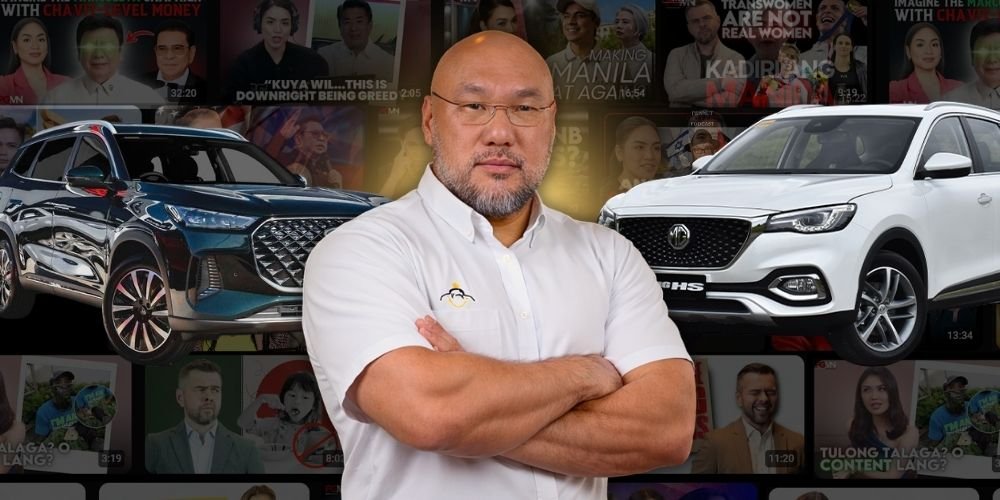
Newest PGMN Anchor King Panda said the Philippine car market is undergoing a structural reset driven by intensified competition and the rapid expansion of Chinese automotive brands, arguing that recent sales growth reflects a shift in value dynamics rather than a sudden increase in household income.
Watch the full episode here:
In a recent episode, the CEO and owner of Luxury Cars Manila and Armored Panda Industries cited industry data showing that 475,094 vehicles were sold in 2024, up 7.64 percent from the previous year. First-quarter sales reached 109,606 units, marking a 12.7 percent increase year on year. He said those figures indicate sustained demand and market expansion.
According to King Panda, the increase in ownership is not the result of salaries “magically” doubling but of intensified competition that forced manufacturers and distributors to adjust pricing, upgrade features, and extend warranty coverage. He pointed to lower entry pricing, longer battery and powertrain warranties among several brands, and technology packages that were once limited to higher-end vehicles but are now available in sub-₱1 million segments.
He said financing normalization also played a role, with banks offering longer terms, bundled insurance packages, and lower down payment structures. Dealer expansion across the country reduced service gaps and made ownership less intimidating for first-time buyers.
Addressing long-standing skepticism toward Chinese vehicles, King Panda acknowledged that earlier models from some brands faced inconsistent quality and weak after-sales support. However, he noted that global quality studies in recent years have documented a narrowing gap between Chinese domestic manufacturers and established international brands. He added that factory build quality alone does not determine ownership satisfaction in the Philippine setting.
He emphasized that after-sales execution remains critical. Parts availability, service competence, claims processing speed, turnaround time, and warranty clarity determine whether a vehicle becomes a reliable asset or a financial burden. “Do not buy the hype. Buy the support system,” King Panda said.
He framed mobility as an economic issue, arguing that vehicle access affects time recovery, income protection, family logistics, and commuter safety. He cited long commuting hours, public transport congestion, and safety concerns as factors influencing buying decisions.
King Panda urged Filipino consumers to compute total cost of ownership, scrutinize dealer capability, and evaluate brands individually rather than rely on marketing campaigns or brand loyalty. He maintained that increased competition benefits buyers by expanding options and pressuring the entire industry to deliver stronger value and improved service standards.