
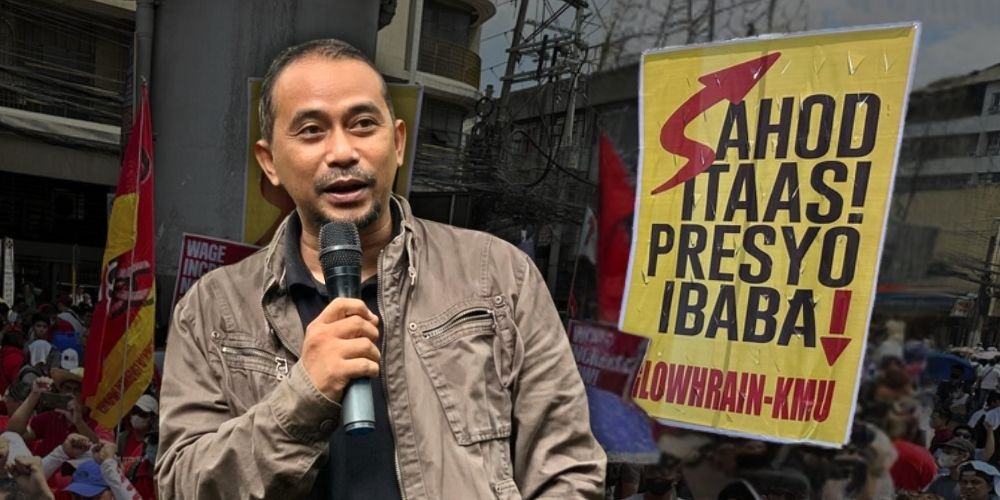
Labor Leader Luke Espiritu renewed his criticism of what he called “starvation wages” in the Philippines, saying he would push for a ₱750 increase on top of existing minimum wages if elected senator in the 2025 midterm elections.
Espiritu said current wage levels keep even full-time workers below the poverty line, arguing that employment in the country no longer guarantees a basic standard of living. He said the situation reflects a systemic failure where workers remain poor despite rendering a full eight-hour workday.
The labor leader, who serves as national president of Bukluran ng Manggagawang Pilipino, said conservative estimates place a living wage at about ₱1,200 per day. He said adding ₱750 to prevailing minimum wages would move workers closer to that threshold. In Metro Manila, where the daily minimum wage stands at ₱645, he said the proposed increase would narrow the gap.
Espiritu made the remarks during an interview on Ikaw na Ba? The Senatorial Interviews aired over Super Radyo DZBB, where he described decades of stagnant pay as unsustainable for ordinary workers.
His statements came as the House of Representatives of the Philippines approved on second reading House Bill No. 11376, which proposes a ₱200 daily wage increase for private sector workers regardless of employment status. The bill also allows small enterprises to access incentives from the Department of Labor and Employment to help them comply.
Several business groups have raised concerns about the proposed ₱200 wage hike, warning of higher operating costs and reduced competitiveness. Espiritu said opposition from employers would surface regardless of the amount proposed, adding that resistance to wage increases has long been a pattern.
Espiritu also said he would push for stricter regulation of the oil and power industries to help ease the cost of living. He reiterated his call to repeal the Oil Deregulation Law, arguing that fuel pricing affects the entire economy by driving up production costs and consumer prices.
He further said he supports scrapping the Electric Power Industry Reform Act, claiming the power sector operates as a natural monopoly vulnerable to price manipulation. He questioned the viability of competition in an industry where consumers have limited choices and alleged coordination between power generators and distributors.
EPIRA, enacted in 2001, restructured the power industry by separating generation, transmission, distribution, and supply in an effort to promote competition and stabilize electricity prices.
Espiritu also criticized the allocation of confidential and intelligence funds to civilian agencies, saying such funds should be limited to offices directly involved in intelligence work. He said the restriction should apply even to the Office of the President and the Office of the Vice President, describing the practice as unjustified.
Data from the Commission on Audit showed that the Office of the President was the biggest spender of confidential and intelligence funds in 2023 at ₱4.56 billion. The Department of Justice followed with ₱683.85 million, while the Philippine Drug Enforcement Agency (PDEA) recorded ₱500 million. The audit body also reported that the Office of the Vice President spent ₱375 million, exceeding the confidential fund use of the Department of National Defense, the National Intelligence Coordinating Agency, and the National Security Council.