

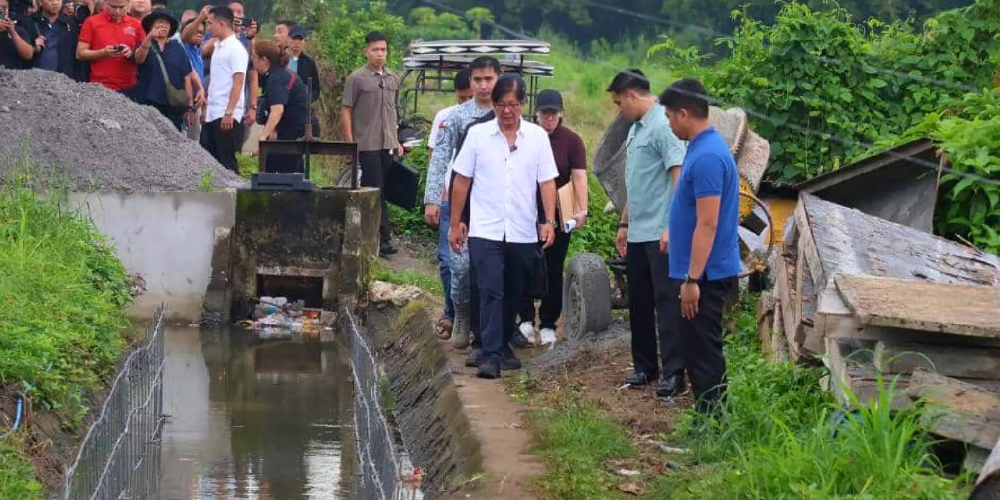
President Ferdinand Marcos Jr. has ordered tighter controls on how public funds are planned and released after a multibillion peso flood control scandal exposed how state money was diverted through questionable and even non-existent projects.
The directive was raised during a meeting of the Economy and Development Council, where Marcos instructed economic managers to strengthen budget safeguards and address long standing weaknesses in flood control spending. Malacañang said the discussion centered on accountability, climate related risks, and the need to prevent a repeat of abuses tied to infrastructure projects meant to protect communities.
Presidential Communications Undersecretary Claire Castro said the President directed agencies to confront the flood control problem directly, including the growing impact of climate change on disaster risks. She said Marcos emphasized transparency in how government money is allocated and spent, particularly in large scale projects that are vulnerable to corruption because of their urgency and scope.
As part of the response, the government has launched a transparency portal that allows the public to monitor the activities of government agencies, including procurement and bidding processes. Castro said the platform is intended to give citizens clearer visibility into how contracts are awarded and how funds move across agencies.
Local governments were also reminded to exercise discipline and openness in managing public funds. Castro said accountability does not stop at the national level and that local spending decisions must withstand public scrutiny.
Marcos also raised the need to improve disaster forecasting, response, and adaptation through the use of modern technology. Officials said the goal is to reduce delays and system failures that leave communities exposed during floods and other climate driven emergencies.
The President further underscored the importance of stronger coordination with other countries, particularly within the Association of Southeast Asian Nations, as part of broader efforts to strengthen economic stability and climate resilience.
Economic managers told Marcos that key indicators show continued recovery. They reported that unemployment fell to 4.7% in 2025 from 10.3% in 2020, while underemployment declined to 13.6% from 16.2% over the same period. They also said the number of poor Filipinos dropped by about 2.4 million between 2021 and 2023, with poverty incidence falling to 17.5 million in 2023 from 19.9 million two years earlier.
In a related move, Executive Secretary Ralph Recto met with officials from the budget department, the Office of Civil Defense, and the Department of the Interior and Local Government to speed up assistance for disaster hit areas. A statement from Recto’s office said he stressed that aid must reach affected families without delay.
Recto also called for simpler vetting procedures for local government requests, warning that bureaucratic bottlenecks slow down relief efforts and weaken the state’s response during emergencies.