

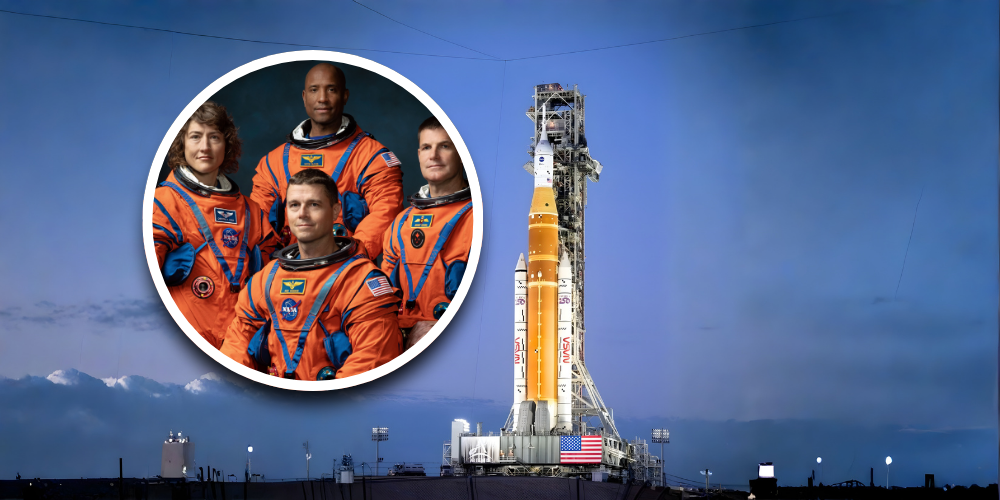
More than five decades after the Apollo program last sent humans beyond low Earth orbit, NASA is preparing a mission designed to go farther than any crewed flight in history. Artemis II, scheduled to launch in early February, will not attempt a lunar landing. Instead, it will test whether humans, spacecraft, and mission systems are ready to operate again in deep space.
The four-member crew will follow a long, looping trajectory that carries them around the far side of the Moon before returning to Earth. At its most distant point, the spacecraft is expected to travel about 4,700 miles beyond the lunar backside. That distance will surpass the record set by Apollo 13, which flew a similar circumlunar path in 1970 during its aborted landing attempt. From that remote vantage point, the Artemis II crew is expected to capture images showing both the Earth and the Moon in the same frame, a perspective no human mission has directly achieved.
The mission draws historical parallels to Apollo 8, the first crewed flight to orbit the Moon in 1968. That mission unfolded during a turbulent year marked by global conflict and political unrest, and it culminated in a broadcast watched by more than a billion people worldwide. Artemis II is not positioned as a symbolic replay, but as a technical proving ground meant to answer a basic question: can sustained human exploration beyond Earth resume after decades of absence?
The crew includes Reid Wiseman, Victor Glover, Christina Koch, and Canadian astronaut Jeremy Hansen. Their flight also marks a demographic shift in lunar exploration. Koch is set to become the first woman to travel to the Moon, Glover the first person of color, and Hansen the first non-American to take part in a lunar mission.
Beyond the crew, Artemis II serves as a critical test of NASA’s Space Launch System rocket and Orion spacecraft. The mission’s success would clear the way for later flights aimed at establishing a long-term human presence near the Moon’s south pole. If it fails, it would force NASA to reassess ambitions that have remained dormant since the Apollo era ended in 1972.

President Bongbong Marcos said the Philippines is taking steps to strengthen its tourism sector, as he highlighted the need for better infrastructure during an event in Lapu-Lapu City,...
Read moreDetails