

The Philippine Army has rolled out a locally developed remote weapons system as it accelerates a shift toward troop protection, sustainment and self-reliant defence production while rebalancing from internal security to external defence.
The Controller Operated Battle-Ready Armament system, known as Cobra, was formally turned over by the DOST to the Department of National Defense and the Philippine Army at Camp O’Donnell in Capas, Tarlac after two years of development.
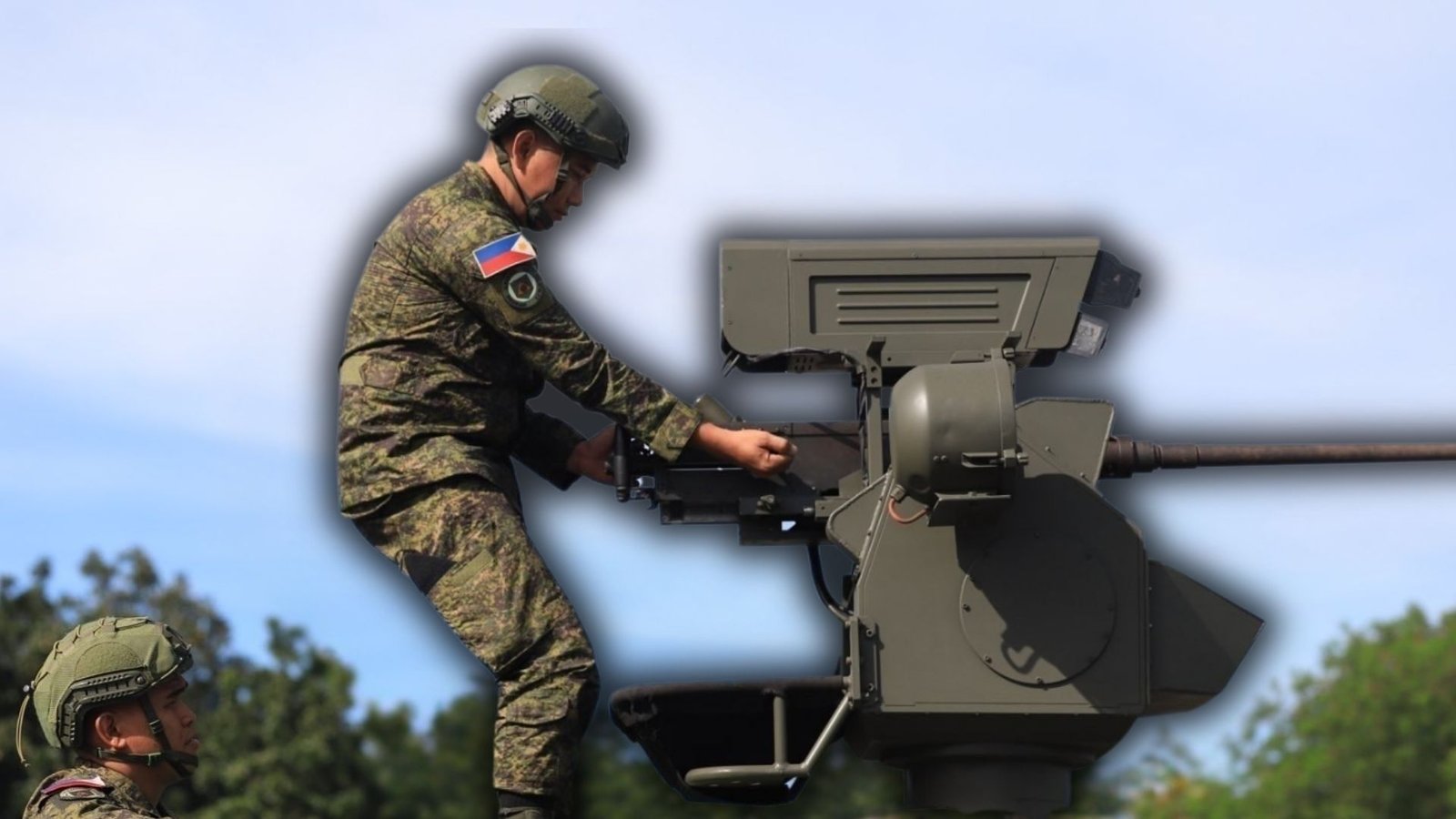
Designed and engineered by the Department of Science and Technology’s Metals Industry Research and Development Center, Cobra integrates a .50-caliber remote weapon station onto armoured vehicles, allowing soldiers to engage targets from inside protected compartments and reducing exposure to direct fire.
The project was developed with a combined budget of ₱29 million, with ₱24 million from the Department of Science and Technology and ₱5 million from the Department of National Defence.
“Cobra enhanced ‘soldier survivability by allowing operation of the weapon system from the safety of the vehicle’s interior, protecting personnel from direct fire,’” said Chester Cabalza, founder and president of Manila-based think tank International Development and Security Cooperation.
At the turnover ceremony, Defence Secretary Gilberto Teodoro Jr said Cobra advances the Self-Reliant Defence Posture program by strengthening local research, production and institutional capacity.
“The strategy is clear: we start by strengthening the foundations – the research, the production capabilities and institutional support – then build upwards, layer by layer, until we have an industry that can stand strong and succeed on its own,” Teodoro said.
Army chief Lieutenant General Antonio Nafarrete said Cobra supports the Army’s land-centric posture under the Comprehensive Archipelagic Defense Concept as the military prepares for external defence scenarios.
“It symbolises our collective pursuit of a self-reliant posture through science, technology and innovation and is part of the military’s broader modernisation and capability upgrade efforts,” Nafarrete said.
DOST-MIRDC Prototyping Division chief and project lead engineer Rodnel Tamayo said Cobra replaces manual gun mounts that historically exposed soldiers to enemy fire.
“With the manual, it’s very dangerous for soldiers. They are exposed to enemy fire. All the operations in manning the gun, firing the gun will be done inside the APC. This is automated na,” Tamayo said.
Tamayo said most components are locally sourced, allowing faster repairs and easier maintenance. He said Cobra units produced in batches of 20 could cost between ₱8 million and ₱10 million each, significantly cheaper than imported remote weapon systems.
Asked how many units the Army plans to initially produce, Nafarrete said, “Siguro 20 muna ang pwedeng i-reproduce natin.”
Tamayo said Cobra has undergone extensive testing, including 360-degree target tracking and engagement of moving targets at speeds of up to 30 kilometers per hour.
The system forms part of a broader push into unmanned and remote capabilities. In November, the Army announced a parallel project with the University of Santo Tomas to develop the Surveillance and Field Evaluator for Ground-based Unmanned Autonomous Robot, known as Safeguard, for surveillance and field evaluation.
Arnaud Leveau, a geopolitics professor at Paris Dauphine University, said remote and unmanned systems offer clear advantages but face operational limits.
“Communications resilience is critical. Any remotely operated or semi-autonomous system is vulnerable to jamming, disruption or cyber interference if it is not designed with redundancy and disciplined electromagnetic management,” Leveau said.
“Training is another constraint. Operating unmanned systems effectively requires not only skilled operators but maintainers, planners and commanders who understand their limits and risks. Sustainment is also often the decisive factor,” he said.
Leveau said batteries, sensors, spare parts and repair cycles determine whether systems remain operational months after deployment, not how they perform during demonstrations.
“Scaling is less an engineering challenge than a procurement and logistics one,” he said.
Set against the regional landscape, Leveau said the Philippines is neither the most advanced nor the least prepared military in Southeast Asia, underscoring both the promise and limits of systems such as Cobra.
“What distinguishes the Philippines today is the clarity of its strategic shift towards external defence and its growing exposure to alliance-driven operational learning,” he said.
Cabalza said the rollout marks a break from reliance on imported systems.
“At least we are now producing our own military armaments and not just shoppers of sophisticated and expensive military assets. This is the true essence of military modernisation,” he said.
Project Cobra is backed by Republic Act No. 12024, the Self-Reliant Defence Posture Revitalization Act.
“This achievement shows that we have the skill, capacity and drive to advance our SRDP journey,” said DND Defence Technology Research and Industry Development Undersecretary Rene Diaz.
Teodoro said Cobra delivers immediate battlefield value.
“Cobra will enhance the Philippine Army’s firepower while improving troop safety by allowing engagement from protected positions,” he said.