


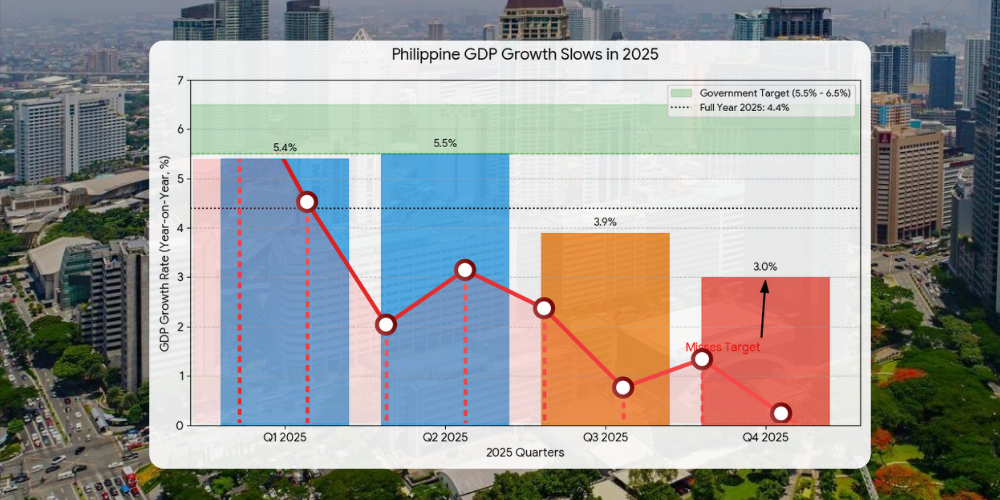
The Philippine economy slowed sharply in the final quarter of 2025, with gross domestic product expanding by just 3.0 percent, marking one of its weakest growth rates since the pandemic and coming in below market expectations. Data released by the Philippine Statistics Authority showed the Q4 figure declined from a downward-revised 3.9 percent in the previous quarter, reflecting softer momentum across key sectors.
The fourth-quarter result fell short of economists’ forecasts, which had clustered around the 4 percent mark, and dragged full-year economic growth to about 4.4 percent. This placed 2025 growth well below the government’s official target range of 5.5 to 6.5 percent, extending a trend of missed growth targets amid persistent domestic and external headwinds.
Economic managers and analysts pointed to weaker household consumption, slower government spending, and cautious private investment as major factors behind the deceleration. Public construction activity lost steam toward the end of the year, while higher borrowing costs earlier in 2025 continued to weigh on business expansion plans. External demand also remained uneven as global growth slowed and trade conditions stayed volatile.
The weaker economic print reinforced expectations of a more accommodative policy stance from the central bank. The Bangko Sentral ng Pilipinas has already implemented a series of rate cuts to support domestic demand, with policymakers signaling they are prepared to respond further should growth risks intensify. Economists said slower output growth could strengthen the case for additional easing in the coming months, particularly if inflation remains manageable.
Despite the slowdown, officials stressed that the economy continues to expand and that structural reforms, infrastructure programs, and easing financial conditions could help stabilize growth in 2026. Still, the Q4 outcome underscored the fragility of the recovery and heightened scrutiny on how quickly spending and investment can rebound in the year ahead, especially as regional peers post stronger economic performances.