


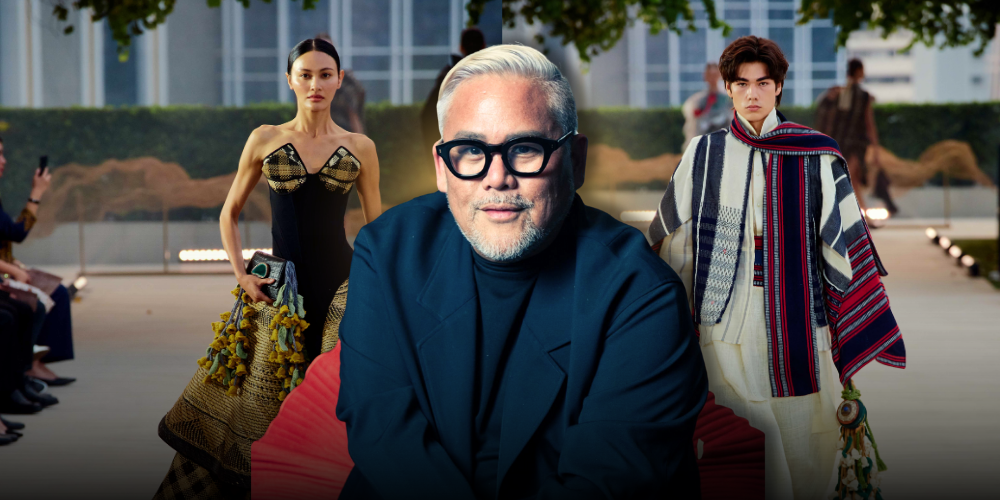
Rajo Laurel made a strong international statement in Bangkok with “LAHI,” a 33-piece couture collection presented at Dusit Thani Bangkok during Bangkok Design Week. The showcase placed Filipino design on a global runway while keeping its narrative firmly rooted in national identity.
LAHI explored the Filipino self through sculptural silhouettes, controlled volume, and deliberate restraint. Laurel treated fashion as language—asking who the Filipino is today and responding with garments that balanced strength and fluidity, history and modern form.
Material shaped the collection’s impact. Jusi, raffia, raw silk, paper silk, ramie linen, and indigenous textiles were crafted into pieces that felt architectural without rigidity. Influences from Iloilo, Abra, Benguet, Dumaguete, Palawan, and Mindanao were embedded as structure rather than surface, translating heritage into contemporary, wearable couture.
Collaboration was central to the work. Accessories and handcrafted elements were developed with Filipino creatives Arnel Papa, Celestina Maristela Ocampo, Cholo Ayuyao, Monchèt Diokno Olives, and MX Studio by Maxine Santos Tuaño. LAHI embodied bayanihan as a shared creative effort.
The presentation was supported by the Department of Trade and Industry (DTI) through the Philippine Creative Industries Development Council, in partnership with Thailand’s Creative Economy Agency, positioning the runway as a platform for cultural exchange.
Heritage was handled with precision. The influence of Baguio master weaver Nada Capunan appeared through technique and material sensibility, honored through adaptation rather than replication.
Set against the Bangkok skyline at golden hour, the message was clear: Filipino fashion does not need translation to belong globally. With LAHI, Laurel delivered couture that crossed borders without compromise—confident, assured, and unmistakably Filipino. This was not an introduction. It was a statement.