
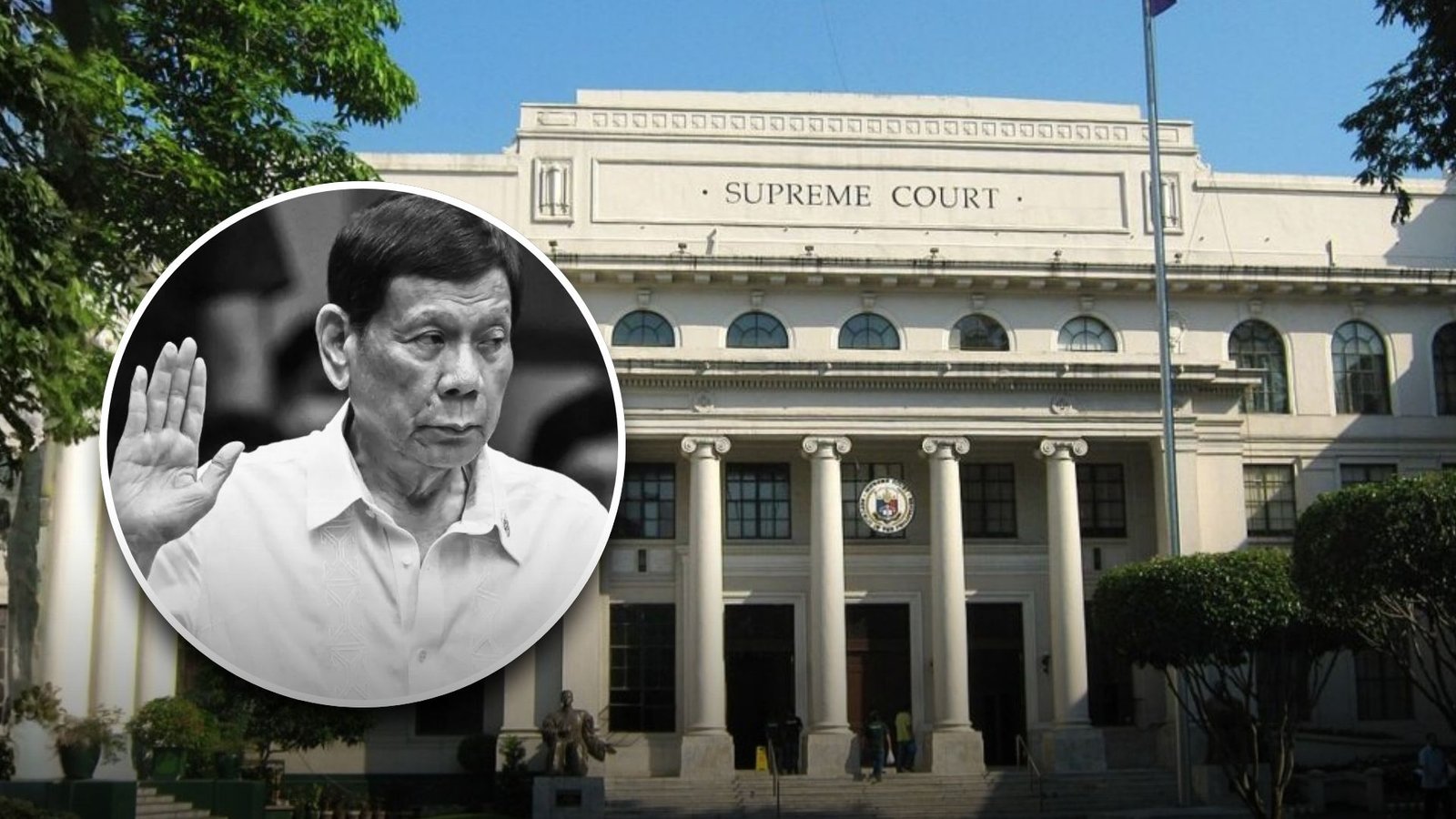
The Supreme Court En Banc has opened a major inquiry into the arrest and transfer of former president Rody Duterte to the Hague, directing all parties to submit complete memoranda within 30 days.
The petitions were filed on behalf of the former president by his children Sebastian Duterte, Paolo Duterte, and Veronica Duterte, all questioning whether the government acted within the limits of Philippine law when authorities arrested the Duterte patriarch and turned him over to the International Criminal Court.
The petitions name as respondents the officials in charge during the arrest, including Executive Secretary Lucas P. Bersamin; Justice Secretary Boying Remulla; Interior and Local Government Secretary Jonvic Remulla; Foreign Affairs Secretary Enrique Manalo; Solicitor General Menardo Guevarra; Immigration Commissioner Norman Tansingco; PNP Chief Police General Rommel Francisco Marbil; CIDG Director PMGen Nicolas Torre III; AFP Chief of Staff General Romeo Brawner Jr.; Philippine Center on Transnational Crime Executive Director LtGen Antonio Alcantara; and the officers identified as Capt. Johnny Gulla and Capt. Elmo Segovia.
Duterte was arrested in Manila on March 11, 2025 under an ICC warrant. He was flown out of the country the same day on a government-chartered aircraft and arrived at the ICC Detention Centre in The Hague on March 12, where he was placed under ICC authority. He made his first court appearance on March 14. These events form the backdrop of the petitions now under review.
The Supreme Court is examining whether Philippine officers had any lawful basis to arrest Duterte without a warrant issued by a Philippine judge, and whether the Interpol communication tied to the ICC was enough to justify domestic enforcement action. The justices want the government to explain every step leading to the arrest, including how the Interpol request was received, how it was treated by the Philippine Center on Transnational Crime, and whether it had any legal effect under Philippine law.
The inquiry also covers Duterte’s transfer to The Hague. The Court wants clarity on whether government actions amounted to a surrender or extradition to a foreign tribunal without going through the procedures required by the Constitution and statutory law. It is reviewing whether Article 59 of the Rome Statute, which outlines how arrests and surrenders must be handled, was followed or disregarded, and whether any action unlawfully bypassed Philippine courts.
The justices are also determining the reach of the ICC over the Philippines after its withdrawal from the Rome Statute. They are asking whether the ICC retains authority over acts committed when the country was still a state party, whether RA 9851 continues to operate alongside or independently of the Rome Statute, and whether the government respected the principle that domestic courts should act first before the ICC steps in.
Another issue before the Court is whether any government action interfered with the President’s exclusive power over foreign relations or placed the country in a position that the Constitution does not permit. The justices are testing whether Duterte’s constitutional rights were violated from the moment of his arrest to his detention in The Hague, and whether officers acted outside their legal mandates.
The Supreme Court also wants the parties to address whether the case remains legally alive or whether developments have overtaken the controversy, and if exceptions to mootness apply given the magnitude of the issues raised.
By laying down these questions and demanding full explanations, the Supreme Court signaled its intention to settle the country’s most consequential questions on sovereignty, foreign cooperation, and the limits of government power. The outcome of this inquiry is expected to define how the Philippines handles future arrests connected to international tribunals and how far foreign institutions can influence law enforcement inside the country.