

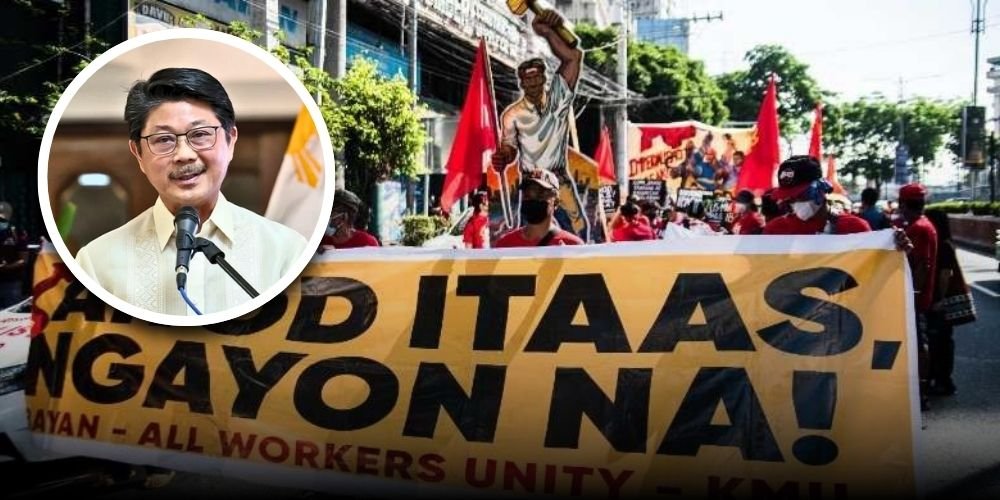
House Speaker Faustino “Bojie” Dy III as committed to approve a national minimum wage rate system that would abolish provincial wage boards, Kamanggagawa Partylist Rep. Eli San Fernando said.
San Fernando said he, Cavite Rep. Ramon Jolo Revilla, Albay Rep. Adrian Salceda and leaders of major labor groups paid a courtesy call to Dy. During the event, the speaker expressed his intention to pass the substitute bill consolidating House Bills 55, 94, 3266, 4102 and 5924, or the proposed National Minimum Wage Act.
“This is historic and a big deal for workers,” San Fernando said.
“This is an opportunity for the leadership of the House to leave a long-lasting economic and wage reform legacy for Filipino workers. We are grateful that Speaker Bojie Dy is stepping up to meet the moment,” he added.
Revilla confirmed on December 10, 2025 that the House committee on labor and employment, which he heads, approved the substitute measure. A still unnumbered substitute bill has been adopted as the bill’s final draft and will be sent to the House plenary for possible second reading.
If enacted, the Regional Tripartite Wages and Productivity Board will be abolished and replaced by a “reorganized and strengthened” National Wages and Productivity Commission.
Under the proposal, the first single national minimum wage will match the rate in Metro Manila, currently P695 per day for non-agriculture sector workers and P658 per day for workers in agriculture, service and retail establishments employing 15 or fewer workers, and manufacturing establishments regularly employing less than 10 workers.
The measure provides for a mandatory three-year transition period, during which all regional minimum wages will gradually align with the national rate by addressing 30 percent of the wage gap in the first year, 35 percent in the second year, and the remaining balance in the third year.
“If this will be passed, this will be a good gift to workers this coming May 1,” San Fernando said. “But more than a gift, it is justice long overdue.”
“This is a rare moment when reform, political will and people’s demand align,” he added. “We intend to make the most of it.”
Revilla said the measure brings the country closer to “giving every Filipino worker a fair, just and modern wage system that recognizes their dignity—no matter where they are in the country.”