

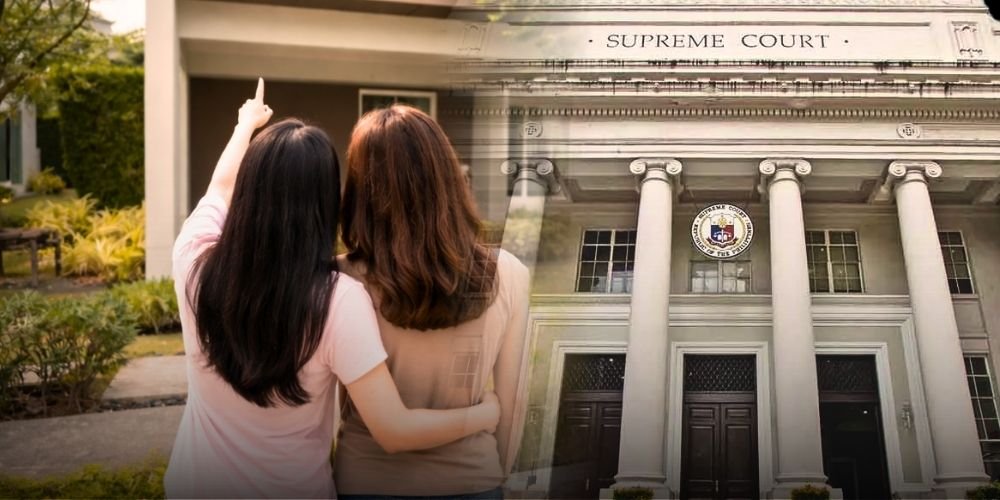
The Supreme Court of the Philippines has ruled that same-sex couples who live together may be recognized as co-owners of property they acquired during their relationship, as long as there is proof that both parties actually contributed to paying for it.
The ruling was issued in G.R. No. 267469, a case involving two women who lived together as a couple and bought a house and lot in Quezon City. The property was registered under only one partner’s name to make bank transactions easier.
After the couple separated, they initially agreed to sell the property and divide the proceeds equally. One partner signed a written acknowledgment stating that the other had paid about half of the purchase price and renovation costs. She later refused to sell the property and denied that her former partner was a co-owner.
The former partner placed an adverse claim on the property title and asked the courts to divide the property. The Regional Trial Court dismissed the case, saying there was not enough proof of contribution. The Court of Appeals upheld the dismissal, prompting the aggrieved party to elevate the case to the Supreme Court.
The Supreme Court reversed the lower courts. It ruled that the written acknowledgment was sufficient proof of actual contribution and established co-ownership of the property. The Court clarified that because same-sex couples are not legally allowed to marry under current Philippine law, their property relations are governed by Article 148 of the Family Code. Under this provision, only property acquired through actual contribution is considered jointly owned, and contributions are presumed equal unless proven otherwise.
In a concurring opinion, Senior Associate Justice Marvic Mario Victor F. Leonen agreed with the outcome but emphasized that the case should be resolved strictly as a property dispute arising from cohabitation, not as a ruling on same-sex marriage. He said Article 148 applies regardless of the parties’ gender and stressed that ownership depends on actual contribution. Leonen pointed to the executed Acknowledgment of Third-Party Interest as strong evidence of the petitioner’s participation in acquiring and improving the property, sufficient to establish co-ownership without expanding marital rights through judicial action.
Associate Justice Amy C. Lazaro-Javier, in her separate concurrence, likewise highlighted the importance of the acknowledgment. She noted that the document was voluntarily signed, repeatedly affirmed, and judicially admitted. Any ambiguity, she said, must be interpreted against the party who drafted it. Based on the document’s clear terms, she concluded that it recognized the petitioner’s 50 percent ownership, entitling her to demand partition of the property as a matter of right.
The Supreme Court also noted that courts alone cannot fully address broader policy questions concerning the rights of same-sex couples. It said Congress and other branches of government must act to address these issues, given the absence of a law recognizing same-sex marriage.
The ruling clarifies that in property disputes involving same-sex couples, proof of contribution—not whose name appears on the title—determines whether a property is jointly owned.