


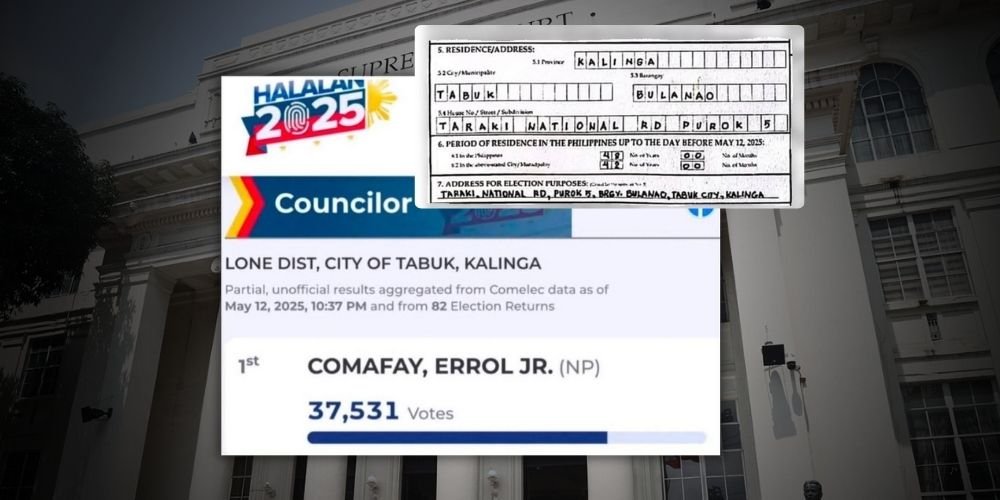
The Supreme Court has cleared the way for Errol Comafay to assume his seat in the Tabuk City council, ruling that a missing comma in his stated address did not amount to material misrepresentation and could not justify the cancellation of his candidacy.
In a unanimous decision issued en banc on January 14, 2026, the Supreme Court granted Comafay’s petition for certiorari and reversed resolutions issued by the Commission on Elections (COMELEC) that had barred his proclamation despite his victory in the May 12, 2025 local elections.
Comafay, a lawyer who garnered the highest number of votes for the Sangguniang Panlungsod of Tabuk City, was never proclaimed after another aspirant questioned how his residential address was written in his certificate of candidacy. In one portion of the document, Comafay listed his address as “Taraki National Rd Purok 5,” while another portion read “Taraki, National Rd, Purok 5, Brgy. Bulanao, Tabuk City, Kalinga.”
Paquinto B. Sallaya, who also ran for the same council post, filed a petition to cancel Comafay’s certificate of candidacy, alleging that no place officially known as “Taraki National Road” existed in Barangay Bulanao and claiming that the omission of a comma amounted to deliberate deception.
The Comelec sided with Sallaya. In a February 2025 ruling, later affirmed en banc, the poll body canceled Comafay’s certificate of candidacy for alleged material misrepresentation, declared his votes stray, and prevented his proclamation. The ruling, however, was elevated to the Supreme Court before it became final.
Because the cancellation of Comafay’s certificate of candidacy was still under appeal at the time of the May 2025 elections, he remained a lawful candidate whose name stayed on the ballot. His votes were cast and counted subject to the final outcome of the case, in line with established election law that only final and executory disqualifications can bar a candidate before Election Day.
In reversing the Comelec, the Supreme Court held that the omission of a comma did not meet the legal threshold for material misrepresentation under Section 78 of the Omnibus Election Code, which requires clear proof that a false statement concerns a candidate’s qualifications and was made knowingly and with intent to deceive.
“The absence of a comma,” the court said, “did not alter the meaning of the address, did not affect the petitioner’s qualifications, and did not mislead either the Commission on Elections or the electorate.”
The court also found no evidence of bad faith, noting that Comafay had consistently used “Taraki, National Road, Barangay Bulanao, Tabuk City” in official records, legal documents, and identification cards for more than a decade. It criticized the Comelec for adopting what it described as an overly literal and narrow interpretation of material misrepresentation.
With the cancellation of his certificate of candidacy set aside, Comafay’s votes are no longer considered stray, removing the legal obstacle that had prevented his proclamation. Local election authorities are now expected to recognize him as a duly elected member of the Tabuk City council.