


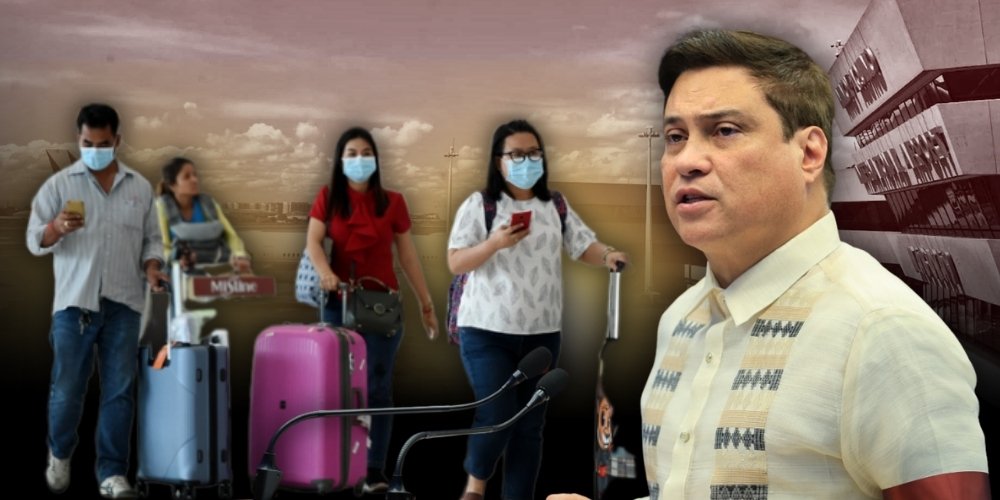
Senate Majority Leader Migz Zubiri has filed a measure seeking to scrap the long-standing travel tax, saying the levy has become outdated and now places an avoidable financial strain on Filipinos traveling overseas.
Zubiri filed Senate Bill No. 1793, or the proposed Travel Tax Abolition Act of 2026, which has been referred to the Senate Committee on Ways and Means as the main committee, with Finance and Tourism as secondary committees. A counterpart bill has also been introduced in the House of Representatives by House Majority Leader Sandro Marcos, who has said he will push for its approval.
Zubiri said the travel tax was introduced in 1977 when foreign travel was treated as a luxury and the government aimed to limit the outflow of dollars, conditions he said no longer apply today.
“It is time to abolish the travel tax. It was created in 1977, in a very different economic era, when foreign travel was seen as a luxury and the government’s priority was to limit the outflow of dollars from the country,” Zubiri said.
He noted that Filipinos now travel abroad not only for leisure but also for work, education, medical treatment, and family reasons, making a flat tax on all departing passengers inconsistent with present-day realities.
Under current rules, Filipinos pay up to ₱2,700 for first-class passage and ₱1,620 for economy class, with the total reaching ₱6,480 for a family of four. Zubiri said these costs add to the financial burden already faced by ordinary households.
The travel tax was imposed under Presidential Decree No. 1183 in 1977 and later referenced in the Tourism Act of 2009. Proceeds from the levy currently fund programs of the Tourism Infrastructure and Enterprise Zone Authority, the Commission on Higher Education, and the National Commission for Culture and the Arts.
Zubiri said the bill includes safeguards to ensure continued funding for these programs through allocations in the annual General Appropriations Act. The proposal would also prohibit further collection of the travel tax once the law takes effect and require refunds for taxes already paid for flights scheduled on or after the effective date.
He said removing the travel tax would ease costs for families visiting loved ones abroad, students studying overseas, and entrepreneurs expanding their businesses, while aligning government policy with the constitutional right to travel and regional commitments such as the ASEAN Tourism Agreement.