

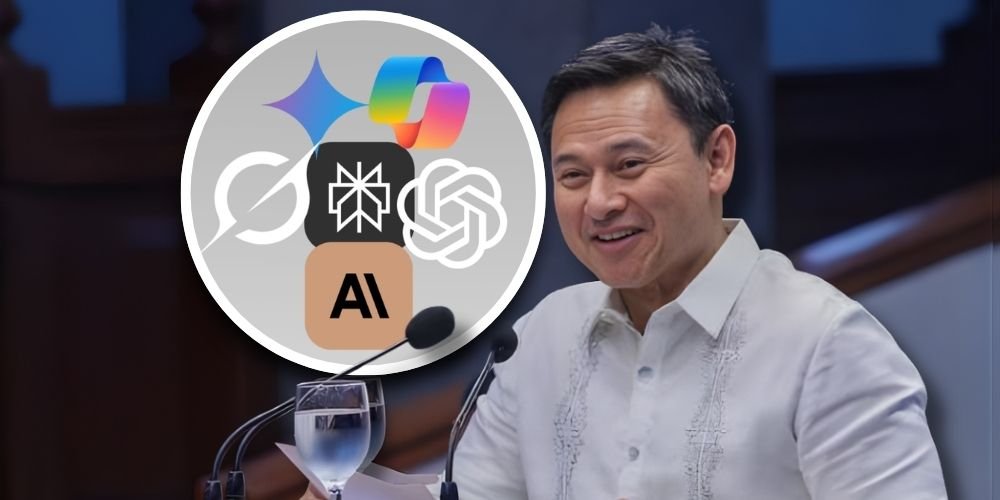
Education Secretary Sonny Angara is moving to put teachers and learners back at the center of the country’s fast-growing use of artificial intelligence in schools.
In a 49-page directive dated Feb. 20, Angara issued DepEd Order No. 003 series of 2026, setting formal guidelines on how AI should be used across classrooms, teaching, learning, and even education governance.
He acknowledged the “rapid expansion” of AI and admitted that its spread has “outpaced the ability of the basic education system to put in place clear, unified and enforceable policies.”
Angara recognized that the absence of a national framework aligned with data privacy laws, content standards, and sound pedagogy led schools to rely on “informal and inconsistent practices.” He warned that “this situation exposes learners to risks such as data privacy breaches, unverified and misleading instructional content, and uneven application of AI tools across schools.”
The order lays down principles anchored on international frameworks, including those of ASEAN and the United Nations Educational, Scientific and Cultural Organization. At the core is a directive to prioritize a “human-centered and pedagogically appropriate interaction” in teaching and learning.
Angara stressed that teachers and learners will remain at the “center” of the learning process, with AI serving only as a support tool for “effective instructional design that responds to diverse learner needs.” The department made clear that “the use of developmentally appropriate AI tools should effectively meet human needs and enhance teaching and learning, driven by the intrinsic motivation of teachers and learners who maintain control over the AI tools.”
DepEd also pushed for inclusion, equity, and cultural and linguistic diversity in integrating AI, requiring that tools be accessible even to the “poorest and most disadvantaged” students. The policy states that AI use must protect human agency and must not compromise the “intellectual and relational skills of all learners.”
In classrooms, the department said AI should strengthen essential 21st-century skills by enabling students to “analyze, evaluate, innovate and effectively communicate ideas and apply learning in real-world contexts.”
The order aligns with the European Union’s AI Act and the Asean 2025 Expanded AI Guide by categorizing AI applications by risk and imposing stricter controls on high-risk uses while allowing innovation for minimal or limited risk tools.
With the new directive, Angara is drawing a line. AI will enter Philippine classrooms, but control stays with teachers and learners.