


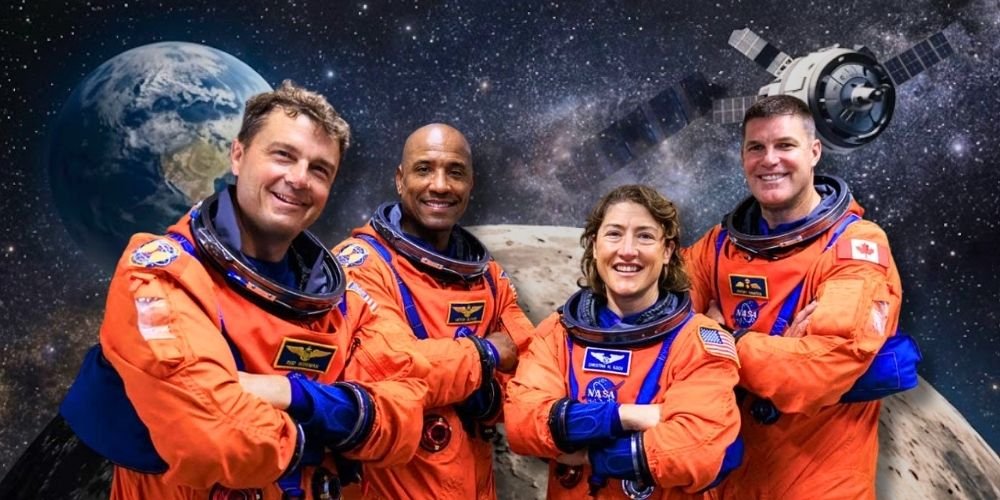
For over five decades, humans reached a distance no one would surpass. Now, NASA Artemis II has broken that historic record. On April 6, 2026, the crew traveled about 406,000 kilometers from Earth, surpassing the distance reached during Apollo 13. The four astronauts flew aboard the Orion capsule as they entered the Moon’s gravitational influence.
The NASA – National Aeronautics and Space Administration previously held the record through Apollo 13, which reached about 248,000 miles, or roughly 399,000 kilometers from Earth. That distance was achieved during an emergency return after an onboard explosion, not a planned mission path. In contrast, Artemis II followed a designed trajectory that used the Moon’s gravity to guide the spacecraft back to Earth.
As Orion moved behind the Moon, communication with Earth stopped for about 40 minutes. The Moon blocked signals, creating a temporary blackout during the flyby. During this period, the astronauts viewed the Moon’s far side, a region rarely seen directly by humans.
The crew spent more than six hours studying and documenting lunar features from about 4,000 miles above the surface. They observed formations such as the Orientale basin, a massive crater previously seen only through uncrewed missions. Astronauts also proposed names for previously unnamed craters during the flight, including one suggested in honor of a personal connection.
“The human eye is basically the best camera that could ever or will ever exist,” Kelsey Young, lead scientist of the Artemis II mission, on how direct observation supports detailed lunar analysis.
The mission also included rare visual events, including a solar eclipse as the Moon blocked the Sun. Astronauts captured views of Earth appearing small against the lunar horizon at record distance. Scientists on the ground monitored these observations in real time as the crew described what they saw.
Engineers are using Artemis II to test spacecraft systems under deep-space conditions. The mission evaluates navigation, crew operations, and reentry protection. These findings will guide Artemis III and Artemis IV, which aim to return humans to the Moon and support future missions.