


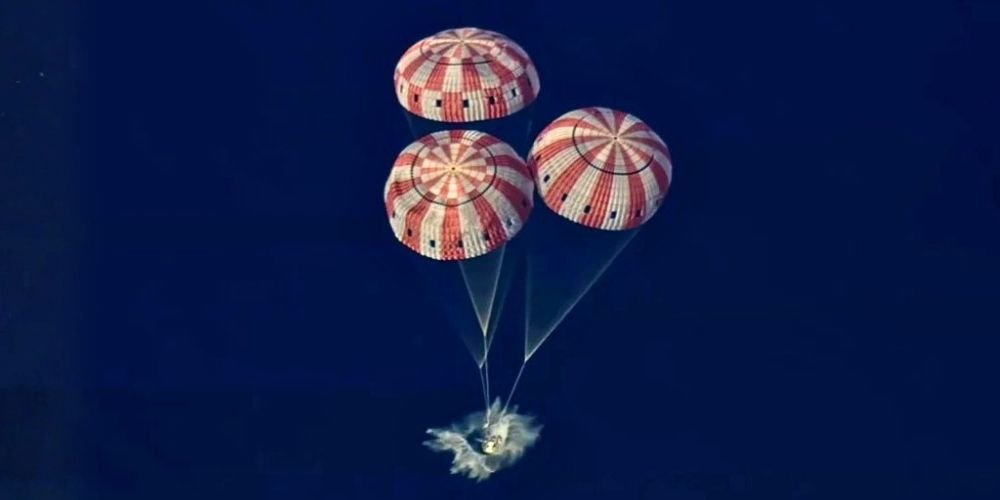
A mission that pushed humans farther than ever now ends with a controlled splashdown back on Earth. NASA Artemis II astronauts safely landed in the Pacific Ocean at 8:07 p.m. ET after completing one of the most demanding returns in modern spaceflight.
The Orion spacecraft re-entered at extreme speeds, enduring intense heat before stabilizing at sea. This closing phase confirms that a record-setting deep-space journey can be executed and brought home safely.
The crew—Christina Koch, Victor Glover Jr., Jeremy Hansen, and Reid Wiseman—completed a roughly 10-day mission that extended beyond previous human limits. Earlier in the flight, they traveled over 406,000 kilometers from Earth, surpassing the distance reached during Apollo 13. The mission followed a planned trajectory that used the Moon’s gravity to guide Orion back, demonstrating controlled navigation in deep space.
Re-entry remained one of the most technically critical stages of the mission. Orion entered Earth’s atmosphere at extreme velocity, exposing the spacecraft to intense thermal stress. NASA adjusted the descent path to reduce time at peak heat levels due to known heat shield concerns. This steeper and faster approach helped secure a stable return under tightly managed conditions.
Recovery operations followed immediately after splashdown. Teams deployed flotation and stabilization systems before opening the hatch, allowing the astronauts to step onto an inflatable platform. Helicopters then transported them to a U.S. Navy ship for medical checks and standard post-mission procedures.
“We are back in the business of sending astronauts to the moon, bringing them back safely,” NASA Administrator Jared Isaacman, on the mission’s role in advancing sustained lunar exploration.
With Artemis II completed, NASA advances to the next phase of its program. The mission provides critical data for future flights aimed at landing astronauts on the Moon and supporting long-term operations beyond Earth.