

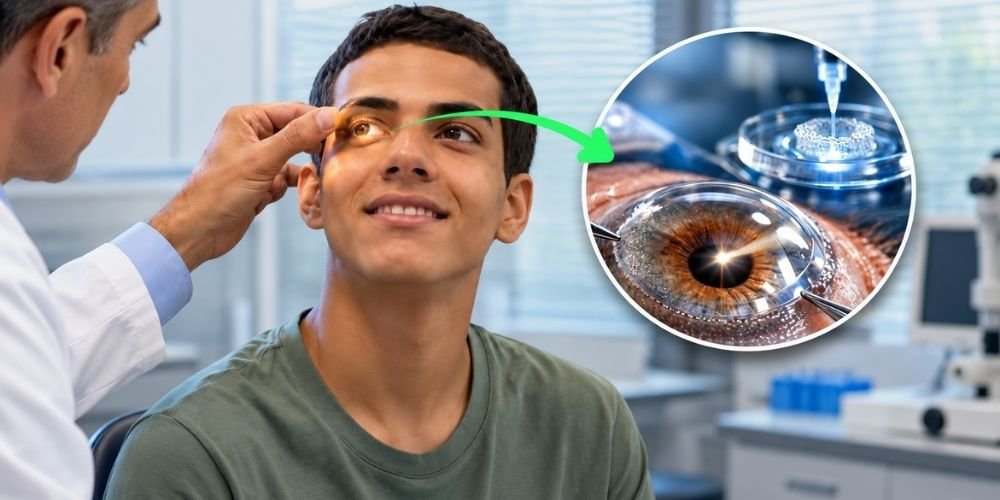
A legally blind patient has regained vision after receiving what Rambam Health Care Campus in Haifa, Israel, described as the world’s first fully 3D-bioprinted corneal implant made from cultured human cells. The procedure marks a significant development in efforts to produce living tissue that can be used for transplantation.
The operation was performed Oct. 29, 2025, by a team headed by Professor Michael Mimouni, director of the Rambam Eye Institute’s Cornea Unit. Precise Bio developed the implant, known as PB-001, using human corneal cells grown in a laboratory and shaped into transparent, layered tissue designed to mimic important characteristics of a healthy cornea.
Rambam said cells obtained from a single healthy cornea donated after death were multiplied in the laboratory to produce approximately 300 implants. Precise Bio estimates that only one donor cornea is available for every 70 people who require a transplant, leaving millions of patients without access to procedures that could restore their sight.
“For the first time in history, we’ve witnessed a cornea created in the lab, from living human cells, bring sight back to a human being,” Mimouni said.
“It was an unforgettable moment—a glimpse into a future where no one will have to live in darkness because of a shortage of donor tissue.”
PB-001 is intended to treat corneal endothelial disease, a condition in which malfunctioning cells in the cornea’s inner layer cause fluid to accumulate, turning the normally clear tissue cloudy and impairing vision. The implant is designed to become integrated with the patient’s existing cornea and can be inserted using currently available ophthalmic surgical equipment. Precise Bio said the implant can also be cryopreserved, transported preloaded on standard delivery devices and unfolded during the procedure.
The surgery forms part of an ongoing Phase 1 clinical trial involving 10 to 15 patients, with six-month efficacy data expected during the second half of 2026.