


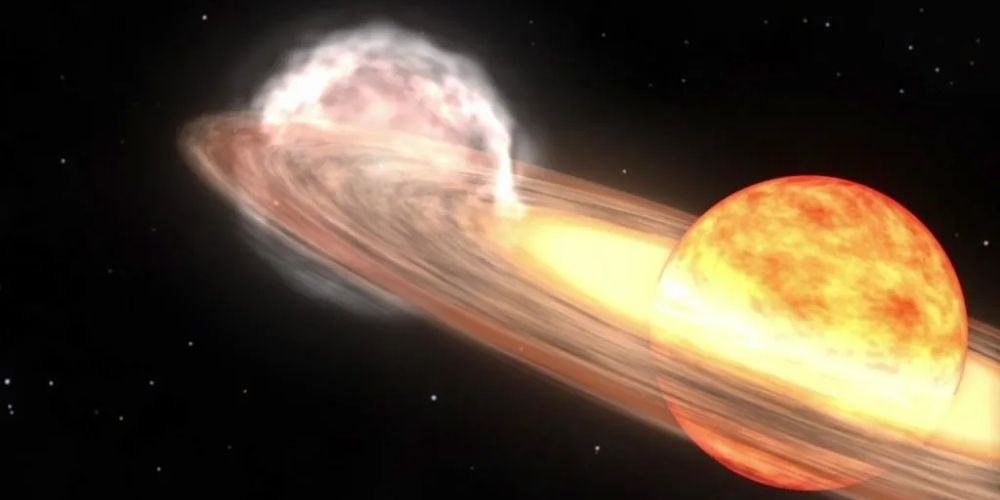
Filipinos may soon get a rare chance to witness a nova with the naked eye as astronomers continue monitoring T Coronae Borealis, a star system about 3,000 light-years from Earth that is expected to erupt and briefly brighten in the night sky.
The system, also known as the Blaze Star, drew renewed attention after a 2024 study identified June 25, 2026 as one statistically likely date for an eruption. Astronomers stress, however, that the timing remains uncertain. Earlier projected dates in March and November 2025 passed without an outburst.
If the nova happens, it will appear as a bright new point of light in Corona Borealis, or the Northern Crown. The constellation can be seen from the Philippines low in the northern sky, especially from areas away from city lights.
T Coronae Borealis is a binary system made up of a red giant and a white dwarf orbiting each other every 228 days. The red giant sheds material that gets pulled onto the white dwarf. As the material builds up, it can trigger a thermonuclear eruption called a nova.
Unlike a supernova, a nova does not destroy the star. The white dwarf survives, allowing the eruption cycle to repeat. T Coronae Borealis last erupted in 1946 and before that in 1866, making it one of the Milky Way’s few known recurrent novae.
Astronomers expect the system to brighten from magnitude 10 to around magnitude 2 if it erupts, making it visible without a telescope for several days before it fades.
For viewers in the Philippines, astronomers recommend looking after 10 p.m. between the bright stars Arcturus and Vega and allowing at least 20 minutes for the eyes to adjust to darkness. NASA and the American Association of Variable Star Observers continue to monitor the system.