

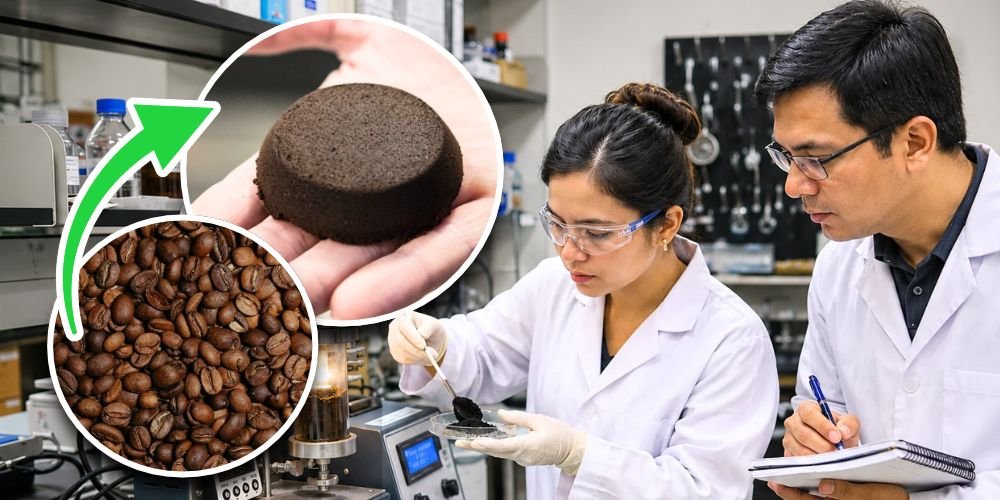
Coffee waste is being transformed into usable fuel in the Philippines as Filipino researchers showcase technology that converts discarded coffee grounds and processing residues into charcoal briquettes.
The Philippine Coffee Board and the Department of Science and Technology’s Forest Products Research and Development Institute (DOST-FPRDI) presented the innovation at the 2nd Philippine Coffee Sustainability Congress on October 15–16, 2026. The process turns coffee by-products into compact fuel blocks that can be burned to generate heat.
Philippine Coffee Board Director Jose “Jo” Mamar and DOST-FPRDI engineer Allan Bondad introduced the technology during the congress. Participants also witnessed a demonstration at the Coffee Technology Center in Amadeo, Cavite, on October 16, showcasing its practical application within the local coffee industry.
Coffee grounds, hulls, and chaff are among the materials left over from coffee processing and preparation. Briquetting technology allows these agricultural residues to be processed and compressed into solid fuel.
DOST-FPRDI has previously developed charcoal briquetting methods using agricultural by-products, including coffee bean hulls. Its documented process involves preparing biomass materials, using binders, and pressing the mixture into compact blocks suitable for fuel.
The initiative builds on an established partnership. In April 2024, Philippine Coffee Board leader Chit Juan disclosed that the organization was collaborating with DOST to convert discarded coffee materials into charcoal briquettes.
For coffee-growing communities, the technology presents a practical opportunity to recover value from agricultural waste. Materials generated during coffee production can serve another purpose as fuel, giving farmers and businesses an additional way to utilize their resources.
The development also highlights the role of Filipino research in finding useful applications for materials already produced by local industries.
With the technology demonstrated in Cavite, the Philippine Coffee Board and DOST-FPRDI have brought attention to a promising application of agricultural waste, showing how the country’s coffee industry can turn everyday discards into a usable energy resource.