


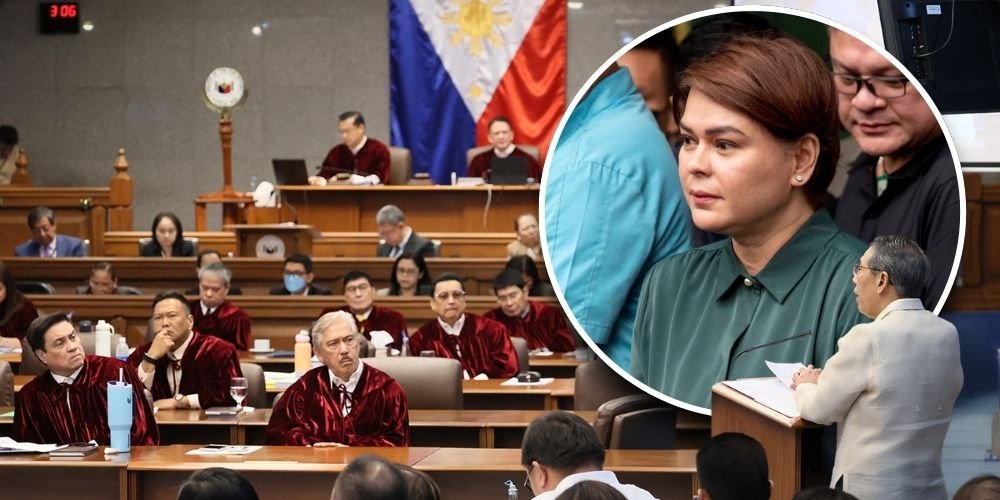
The Senate impeachment court has adopted a new method for determining the conviction threshold in Vice President Sara Duterte’s impeachment trial, basing the required votes on the number of senators legally included in the count. With 20 senators currently counted, 14 votes are required for conviction.
Under the new controlling ruling, the court must first determine, based on “competent and sufficient evidence,” whether a senator falls under any of five circumstances. These include being detained, suspended or otherwise legally restricted from performing Senate duties; being sought by authorities whose whereabouts are unknown; having a physical or medical incapacity; being beyond the Senate’s coercive processes; or being in another situation considered similarly situated.
The senators who remain legally eligible to be counted will then form the denominator for calculating the two-thirds conviction requirement.
The change followed Sen. Erwin Tulfo’s motion to reconsider Presiding Officer Sen. Chiz Escudero’s earlier ruling, which set the threshold at 16 votes based on the full 24-member Senate. Thirteen senators voted in favor of reconsideration, Escudero voted against it, and six abstained. Under the new ruling, the court must separately establish which senators should be included in the count.
After the number of counted senators is determined, any two-thirds calculation resulting in a fraction must be rounded up to the next whole number. With 20 senators counted, two-thirds is 13.33, making 14 votes necessary for conviction. Escudero explained that “a fraction of a vote is impossible, as there is no fraction of a Senator,” requiring the figure to be rounded up. The calculation follows the constitutional requirement that a conviction receive the concurrence of at least two-thirds of the applicable Senate membership.
The changing denominator also means that the number of votes needed for conviction and the number needed to block it do not necessarily decrease at the same rate. With 24 senators counted, 16 votes are required for conviction, while nine opposing votes can block it. At 23 members, the conviction threshold remains at 16, but eight opposing votes are enough to prevent conviction. The threshold drops to 15 at 22 members and 14 at 21, then remains at 14 with 20 senators counted, while the number of opposing votes needed falls to seven.
The same formula applies as the number of counted senators decreases. At four members, three votes would be required for conviction, while two opposing votes would be enough to block it. The opposing-vote figures assume that every senator included in the count casts a vote.
For Duterte’s trial, the issue is therefore not simply the number of senators who are absent. The court must first determine which senators can legally be included in the denominator, with that determination setting the two-thirds threshold for conviction.