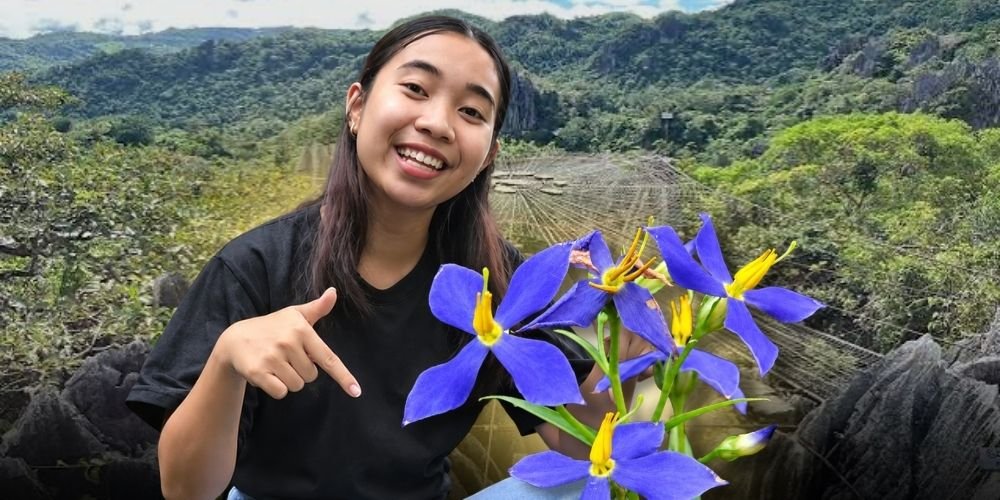
For almost 130 years, Exacum loheri survived in science mostly as an old specimen collected in Rizal in 1895. Now, the tiny bluish-purple flower is blooming again in Masungi Georeserve, where several plants have appeared along the Discovery Trail.
Masungi reported the new blooms on September 13, offering fresh evidence that the rare Philippine-endemic species is still surviving after generations outside the scientific record.
Researchers found the flower alive in Masungi on December 8, 2023—not while searching for it, but during fieldwork on snail habitats. After comparing the plant with scientific literature and historical specimens, they confirmed it as Exacum loheri. The discovery produced the first known photographs of the living species and was formally reported in the Philippine Journal of Science in 2025.
The find closed a gap stretching back to October 26, 1895, when Swiss botanist August Loher collected the species in Montalban, Rizal. For decades afterward, scientists knew it only from preserved botanical material.
Its survival is remarkable for another reason. Exacum loheri has no chlorophyll and cannot make food through regular photosynthesis. Instead, it gets nutrients through fungi in the soil, allowing the small plant to survive on the limestone forest floor.
Kew Gardens records the species as native only to Luzon. Researchers who surveyed other parts of Rizal failed to find another population, leaving the Masungi area as the only currently known place where an intact population has been confirmed.
That makes its continued presence more than a botanical curiosity: the species’ known survival is tied, for now, to a single limestone landscape.
The new blooms are important, but they are not proof that the species is recovering. Scientists have not established whether its population is growing and describe it as “extremely rare and probably threatened” because its known range remains so limited.
For now, the strongest fact is simpler: a flower that vanished from scientific view for more than a century is still here. In the limestone forests of Rizal, Exacum loheri survived unseen long enough to bloom again.