


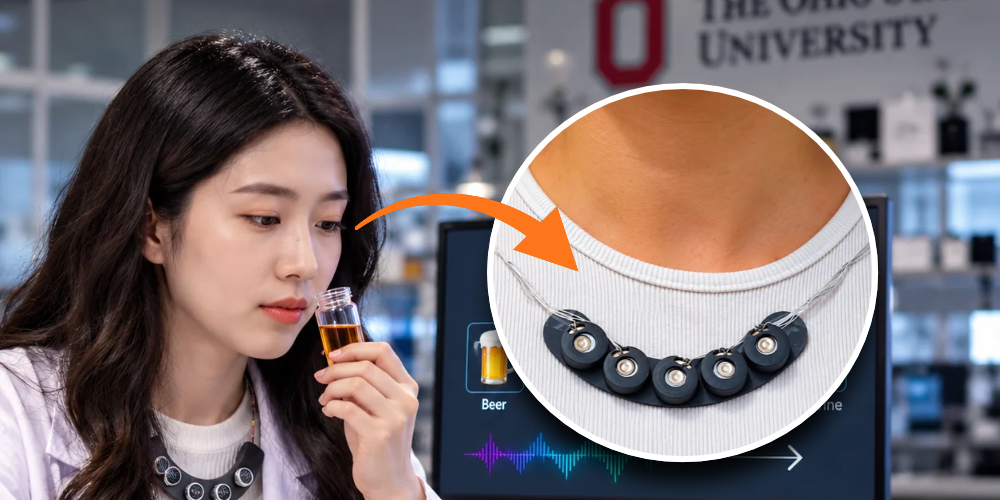
Scientists have developed a prototype that can detect a smell in one location and recreate that aroma somewhere else, opening the door to a future where scents could be shared remotely alongside photos, videos and audio.
The system, called Scentronic, combines an electronic nose, machine learning and a compact scent generator. Researchers say the technology can recognize selected odors, transmit information about them online and trigger another device to release a matching scent at the receiving end.
“In simple terms, it connects ‘smelling something here’ with ‘recreating the corresponding smell somewhere else,’” said Chunyu Yang, an Ohio State University doctoral student in materials science and engineering and lead author of the study published in Science Advances.
The system does not send actual scent molecules through the internet. Instead, its electronic nose detects chemical compounds associated with an odor, a machine-learning model identifies the smell, and digital information is sent to a remote scent generator loaded with matching fragrance materials.
“The idea is to add smell to the visual and audio information we already share remotely, making those experiences more engaging,” Yang said.
Researchers trained the current prototype to recognize five everyday odors including beer, cake, coffee, oranges and red wine. The e-nose uses an array of gas sensors to detect the chemical patterns of those smells before the software classifies them.
“What makes Scentronic different is that it brings odor sensing and generation together for remote sharing. To the best of our knowledge, our study is the first to explore this integration in a compact platform for remote odor sharing,” Yang said.
The electronic nose is roughly 6 inches or 15 centimeters in diameter and is portable. Researchers also produced several versions of the receiving scent generator, including wristband, necklace and handheld designs.
For now, the system remains limited to the smells it has been trained to recognize and reproduce.
“We chose these because they are familiar everyday odors with different scent profiles, making them useful examples for demonstrating the system. We have not yet expanded beyond those categories,” Yang said.
Adding more aromas would require researchers to train the e-nose on new chemical signatures and provide the receiving device with the corresponding scented liquids.
“A broader scent library is possible in principle, but an unlimited repertoire is far beyond what we have demonstrated,” Yang said.
“Recognizing an odor and accurately reproducing it are separate challenges.”
Researchers see possible uses in virtual and augmented reality, online shopping and long-distance communication. A person could eventually share the aroma of a meal with someone in another city or allow shoppers to sample selected scents remotely before buying a product.
“For example, someone could share the scent of a meal with family or friends who live far away,” Yang said.
“Other potential applications include more immersive virtual and augmented reality experiences and online shopping that allows customers to sample selected scents remotely.”
Scentronic is still a research prototype and is not ready for commercial use. Researchers say it would need a larger training dataset, stronger performance in real-world environments and further development of the odor generator before it could move toward wider use.
“At present, this is a research prototype. Moving toward commercialization would require a larger, more diverse training dataset and reliable odor recognition under real-world conditions, where smells often occur in mixtures,” Yang said.
The researchers also said future versions would need to address scent accuracy, refillability, durability, manufacturing cost and the safety of repeated exposure to scented mist.
A smartphone could eventually connect to a scent-generating accessory, Yang said, although fitting the entire system inside a phone would be more difficult because scent reservoirs, electronics and atomizers take up space.