

The Supreme Court has acquitted a woman who killed her abusive police officer husband, ruling that victims of prolonged domestic violence cannot be denied legal protection simply because they failed to document every incident of abuse.
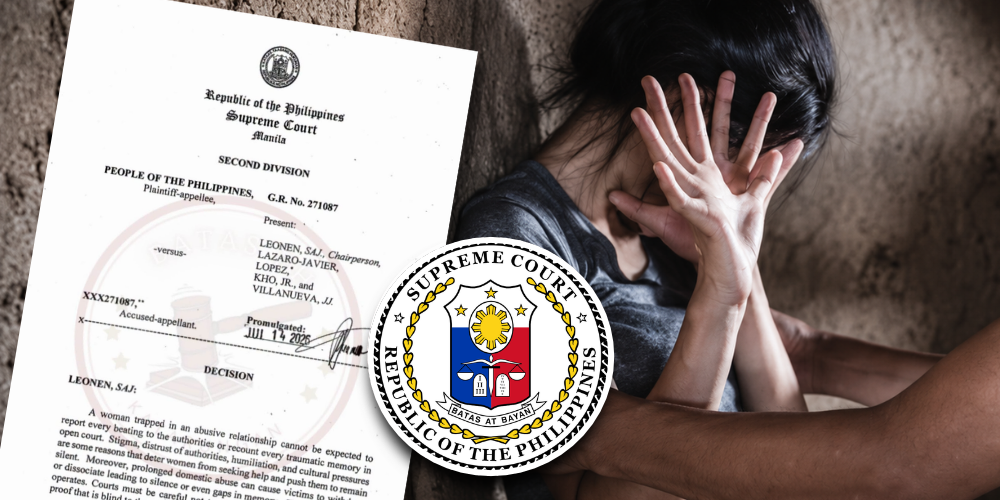
In a 16-page decision promulgated on July 14, 2026, and penned by Senior Associate Justice Marvic Leonen, the Court’s Second Division overturned the woman’s parricide conviction after finding sufficient evidence that she suffered from Battered Woman Syndrome (BWS), a psychological condition associated with repeated physical and emotional abuse.
The ruling, docketed as G.R. No. 271087, provides significant guidance on how Philippine courts must evaluate BWS defenses under Republic Act No. 9262, or the Anti-Violence Against Women and Their Children Act of 2004.
Section 26 of the law provides that victims found to be suffering from BWS incur neither criminal nor civil liability, even when the traditional requirements of self-defense are absent.
The Supreme Court explained that prolonged domestic violence can leave victims experiencing persistent fear and learned helplessness, a psychological state in which they believe they cannot escape their abusers. The law recognizes that such experiences may affect how victims perceive threats and respond to danger.
The Court rejected the Court of Appeals’ conclusion that the woman’s testimony and psychiatric findings were insufficient without additional corroboration from relatives, neighbors, or police records.
It emphasized that victims often remain silent because of fear, humiliation, distrust of authorities, and the psychological effects of trauma. In this case, the woman’s husband was a police officer, which contributed to her reluctance to seek assistance from law enforcement.
“To deny the accused the protection of Section 26 simply because her abuse was not perfectly documented would be to impose upon battered women a burden the law itself never intended,” the Supreme Court stressed.
The decision builds on the landmark 2004 case People v. Genosa, which first recognized BWS in Philippine jurisprudence but ultimately upheld the woman’s conviction because she could not satisfy the traditional, rigid requirements of immediate self-defense.
Unlike in Genosa, the Supreme Court applied the modern framework of Republic Act No. 9262. The justices clarified that under Section 26, once a totality of medical and psychological evidence establishes BWS, the victim is fully protected by law—shattering the old requirement that an abused woman must prove a perfect paper trail or an immediate physical threat at the exact moment of the killing.
The justices clarified that the absence of exhaustive documentation does not invalidate a BWS defense when the totality of evidence, including medical findings, expert testimony, and the circumstances of the violence, sufficiently establishes the condition.