

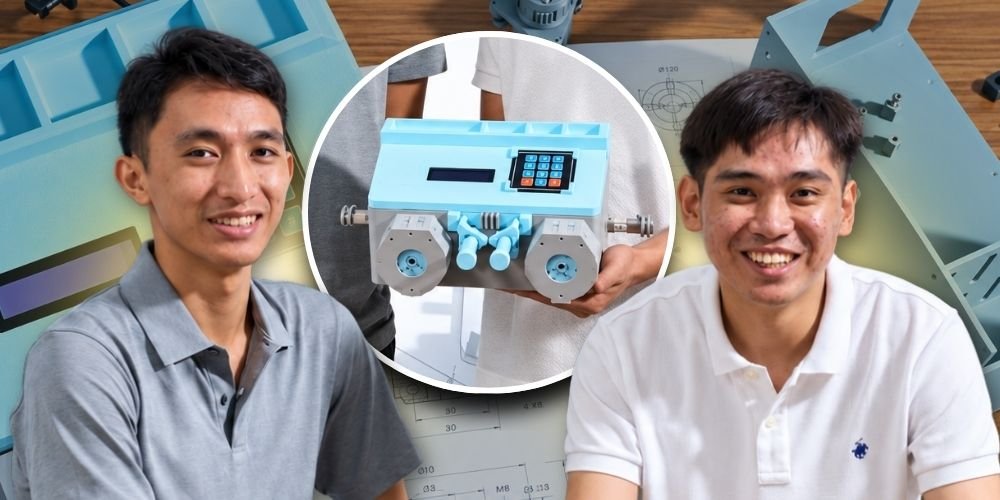
Two UP Diliman have developed BiDaKidney, a low-cost dialysis machine prototype that could help reshape how some kidney disease patients manage treatment in the future.
Andrew Jacob Buensalido and Allyson Cabrestante created BiDaKidney, a semi-automated peritoneal dialysis machine designed to help patients perform home-based dialysis with less manual effort. The device automates the fill-and-drain process using peristaltic pumps that move dialysis fluid, load cells that measure fluid volume, and a microcontroller that controls the treatment cycle.
The project won the Philippine national title in the 2026 The James Dyson Award on Sept. 16, earning the team ₱398,280 for further development. It also received the Dr. Francis Chua Innovation Award and was named Best Capstone Project of the UP Diliman Department of Mechanical Engineering.
BiDaKidney addresses a major challenge in dialysis care, the cost and difficulty of accessing treatment. Commercial automated peritoneal dialysis machines can cost more than US$10,000, while the team is targeting a device cost of around US$100. At about 2.5 kilograms, the prototype was designed for use at homes, schools, and workplaces.
For patients who rely on dialysis, treatment can require significant time, money, and adjustments to daily routines. The developers designed BiDaKidney to make peritoneal dialysis easier to manage by reducing the work involved in repeated fluid exchanges while keeping the system compatible with commonly available dialysis sets.
“‘Bida’ is Filipino for hero, and we took this opportunity to work on an undergraduate capstone project that had the potential to reach each and every Filipino CKD fighter – each and every ‘bida’,” the students said.
The team said BiDaKidney is “an upgrade to manual PD rather than as a direct competitor to high-end automated cyclers,” focusing on essential automation without costly specialized components.
BiDaKidney remains a prototype and has not yet been approved for clinical use. The developers plan to conduct formal testing, improve safety and usability, and continue evaluations with healthcare professionals and patients.