

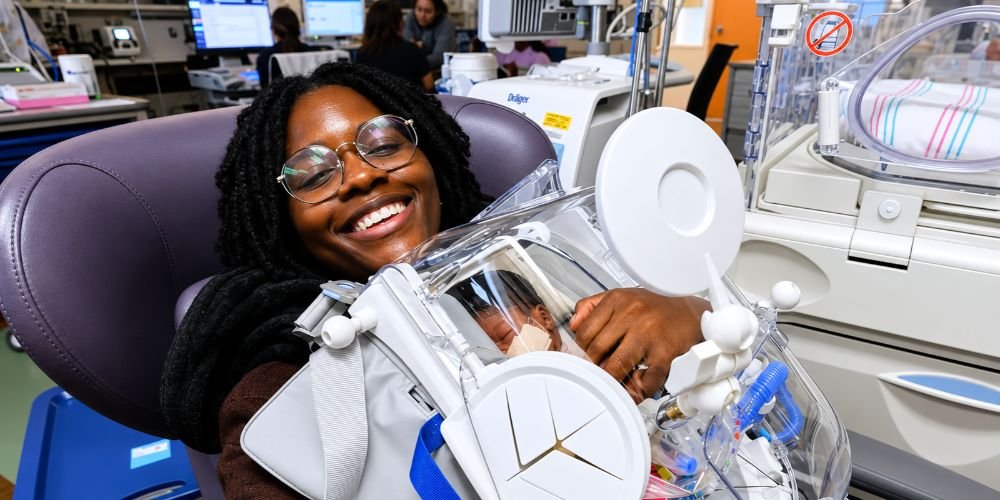
A wearable incubator is allowing premature babies to rest against their parents’ chests while remaining connected to essential medical equipment, marking a promising development in neonatal intensive care.
Children’s Memorial Hermann Hospital in Houston, Texas, has become the first US hospital to introduce the Skincubator into its neonatal intensive care unit through a clinical trial.
The device maintains a warm, humid environment around medically fragile newborns while securing breathing tubes, catheters and monitoring equipment. A retractable pad allows medical teams to transfer babies onto a parent’s chest with minimal handling, making prolonged skin-to-skin contact more accessible.
The medical benefits are substantial. The World Health Organization recommends eight to 24 hours of daily skin-to-skin care for premature and low-birth-weight babies. A 2023 review of 31 clinical trials involving 15,559 infants found that kangaroo mother care reduced the relative risk of early death by 32% and severe infection by 15% compared with conventional care.
Dr. Jaclyn Ruggiero, principal investigator of the hospital’s Skincubator trial, explained the importance of physical contact.
“It turns on a part of the nervous system that’s really important for connection and feeling calm,” she said.
Early research has also produced encouraging results. A 2025 study found that the median temperature drop during transfer was 0.2°C with the Skincubator, compared with 0.4°C during conventional skin-to-skin care.
Another study published in 2026 recorded 103 successful transfers out of 106 attempts, with sessions averaging 146 minutes.
For Dorian Ojemen, whose twins were born at just 26 weeks, the technology helped ease the fear of holding his medically fragile newborns.
“It took a lot of that fear and anxiety about messing things up away,” he told Parents.
The ongoing Houston trial aims to enroll 60 premature infants and examine skin-to-skin contact duration, infant safety and parental stress.
The innovation offers families facing prolonged hospital stays a new opportunity to hold their newborns while maintaining the medical protection they need.