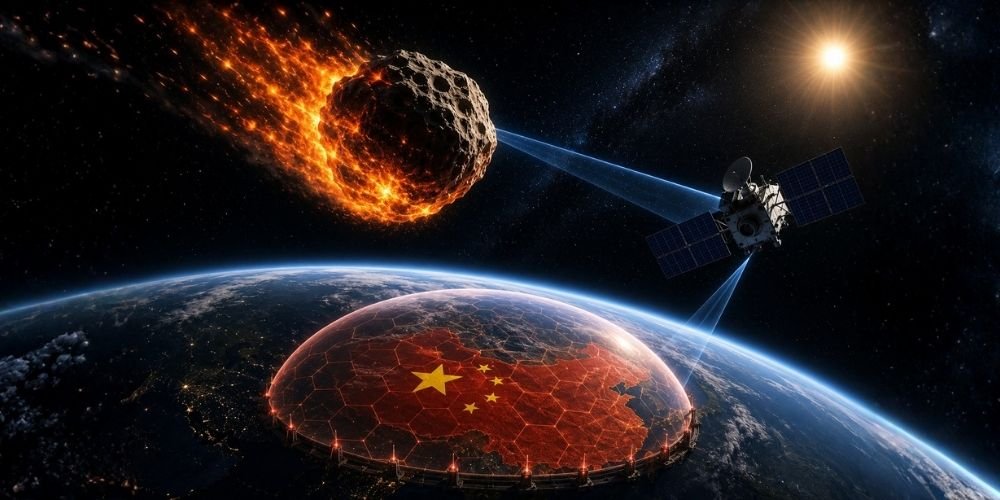
China is developing a space-ground early-warning network designed to detect dangerous asteroids before they approach Earth, combining large optical telescopes with a constellation of orbital observatories that can track threats hidden from ground-based systems.
The project remains under feasibility study and will form a central part of China’s planetary defense program, according to Li Mingtao, chief scientist at the asteroid monitoring and early-warning research center under the China National Space Administration.
China plans to place multiple large-aperture telescopes at carefully selected sites with clear skies, high elevations and stable atmospheric conditions. The geographically distributed network would scan broad sections of the night sky and produce precise measurements of newly detected objects.
Orbital telescopes would cover the system’s largest blind spot by searching for asteroids approaching from the direction of the sun. Unlike ground observatories, satellites would not be restricted by daylight, cloud cover or atmospheric interference, allowing the network to maintain continuous surveillance around Earth.
“These undiscovered near-Earth asteroids pose the greatest risk. They are numerous, very faint before their approach and may even suddenly approach from the direction of the sun,” Li said.
More than 40,000 near-Earth asteroids have been discovered and catalogued worldwide. Scientists estimate that more than 95% of those measuring over one kilometer across have already been identified, with none expected to strike Earth within the next century.
The larger gap involves smaller asteroids that remain capable of catastrophic destruction. Only about 45% of objects measuring roughly 140 meters across have been discovered, according to Li. An asteroid of that size could devastate a small or medium-sized country, while the discovery rate drops further for objects measuring only tens of meters.
“That is why the world is stepping up efforts to strengthen monitoring and early-warning capabilities and catalogue these asteroids as soon as possible,” Li said, adding that “we cannot take the impact risk lightly, nor do we need to be overly anxious.”
Once the network detects a suspicious object, China’s developing warning system would automatically calculate its orbit and determine the probability of an Earth impact. Authorities would receive an alert when the system identifies a credible and urgent threat.
China has also reported progress in developing models and algorithms that assess collision risks. The planned network would connect those tools with telescope observations, turning raw detections into impact forecasts and earlier warnings.
Li said kinetic impact currently offers the most practical method of deflecting a dangerous asteroid by crashing a spacecraft into it and changing its trajectory. NASA demonstrated the technique in 2022 when its DART spacecraft struck Dimorphos and altered the asteroid moonlet’s orbit.
China’s proposed network would give its planetary defense system the ability to search the entire sky, track previously unseen objects and calculate whether intervention is needed before an asteroid becomes an immediate threat.