

China is putting scientists on billboards usually reserved for brands and celebrities, turning urban screens into tributes to the people behind advances in food, medicine, aerospace and nuclear technology.
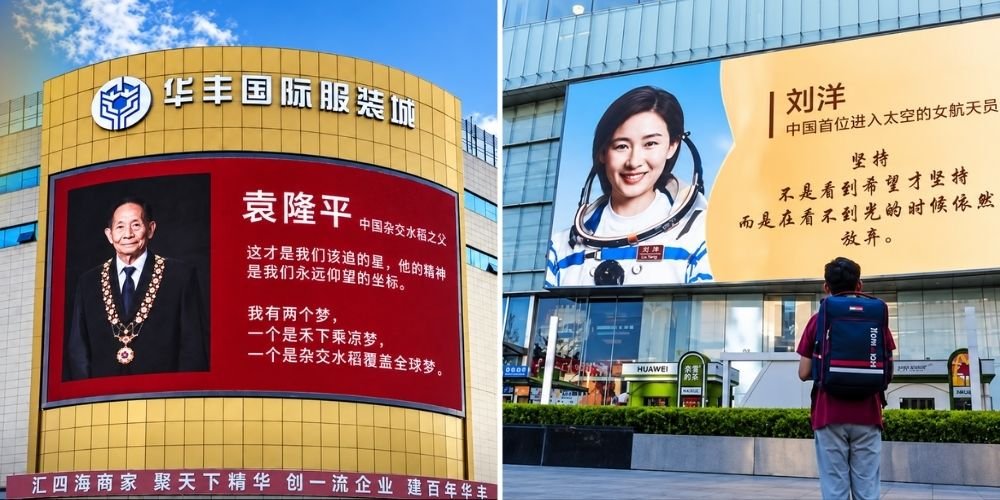
A verified image shows agronomist Yuan Longping on a mall screen in Luxi New Area, Heze, Shandong. The August 21 photograph was part of displays honoring Qian Xuesen, Deng Jiaxian, Qian Sanqiang and Huang Xuhua.
The poster carries Yuan’s “two dreams” of resting beneath tall rice plants and seeing hybrid rice cover the world. Yuan pioneered hybrid-rice research and was the first scientist to exploit hybrid vigor in the crop. His high-yield varieties earned him recognition as the “father of hybrid rice” and China’s Medal of the Republic. Others contributed to aerospace, nuclear science and nuclear-submarine development.
By late August, projects had been documented in Heze, Hulunbuir, Hefei and Ji’an. Chongqing’s Jiefangbei district began a display on August 24. On September 9, Changji launched posters at 10 malls, parks, roadside screens and bus stops, featuring Yuan, Qian Xuesen, Nobel laureate Tu Youyou and railway engineer Zhan Tianyou.
The arrangement varies. Some businesses temporarily surrendered advertising space, while others rotated tributes with paid promotions. One Changji mall alternated public-service content and commercial advertising throughout the day.
This qualifies the viral claim that China replaced celebrity billboards with scientists to inspire young minds. The displays are real and spread across multiple cities, but no nationwide order, permanent removal of celebrity advertising, total number of screens or uniform campaign period has been established. Official descriptions say the projects were meant to spread the accomplishments of national role models. Their effect on children has not been measured.
The story remains larger than one photograph. Screens normally used to sell products are showing who improved rice production, advanced aerospace and nuclear technology, and developed life-saving medicine. For a time, urban space has been redirected toward people whose work shaped food security, engineering, science and public health.