

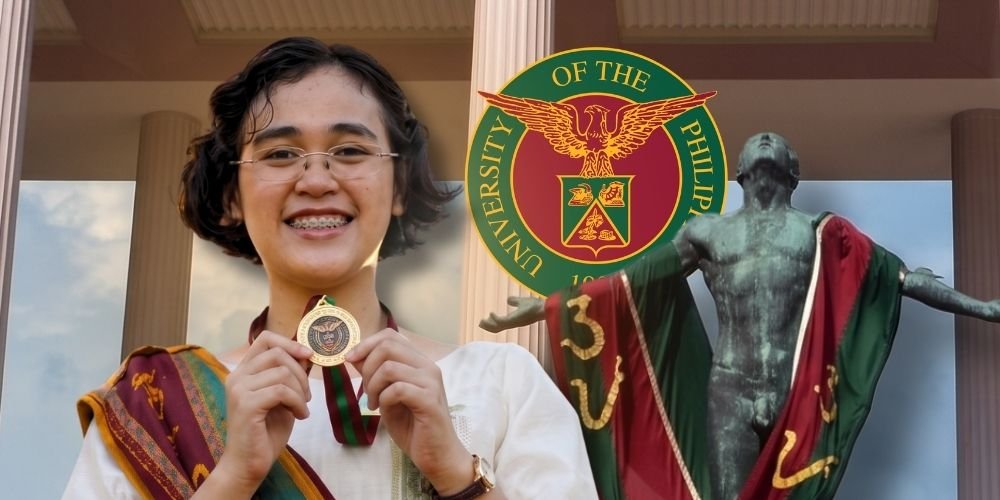
Mikaela Irene Fudolig entered the University of the Philippines Diliman at 11, after completing only her first year at Quezon City Science High School.
She began taking college subjects in 2002 through a prototype early college program for gifted learners. UP first admitted her as a non-degree student while university officials assessed her academic ability and her capacity to adjust to life on campus.
By age 12, Fudolig had completed 31 college units. Her subjects covered algebra, trigonometry, calculus, physics, chemistry, biology, English, and history. Her recorded grades ranged from 1.0 to 1.75.
Her case required special action because she had no high school diploma. Education Secretary Edilberto de Jesus approved her entry into college and supported her application to UP. Vice President for Academic Affairs Maria Serena Diokno later recommended her formal admission to the Bachelor of Science in Physics program for academic year 2003–2004.
UP also examined the risks of placing a child in a university environment. College of Education Dean Leticia Peñano-Ho monitored Fudolig’s progress and took part in an assessment involving the student and her parents. Physicists Jose Balmaceda and Jose Magpantay joined the process after Fudolig expressed an interest in mathematics and chose physics as her preferred field.
The university record stated, “They all agree that U.P. should take her in.”
Fudolig completed her BS Physics degree in 2007 at 16. She graduated summa cum laude with a general weighted average of 1.099 and became valedictorian of the UP Diliman graduating class.
She remained in the university after graduation, serving as an instructor at UP Diliman from 2007 to 2013. She later completed her master’s and doctoral degrees in physics.
Her research eventually expanded into computational social science, a field that uses data and mathematical tools to study human behavior. Her work involved statistics, machine learning, network science, signal processing, and digital records.