


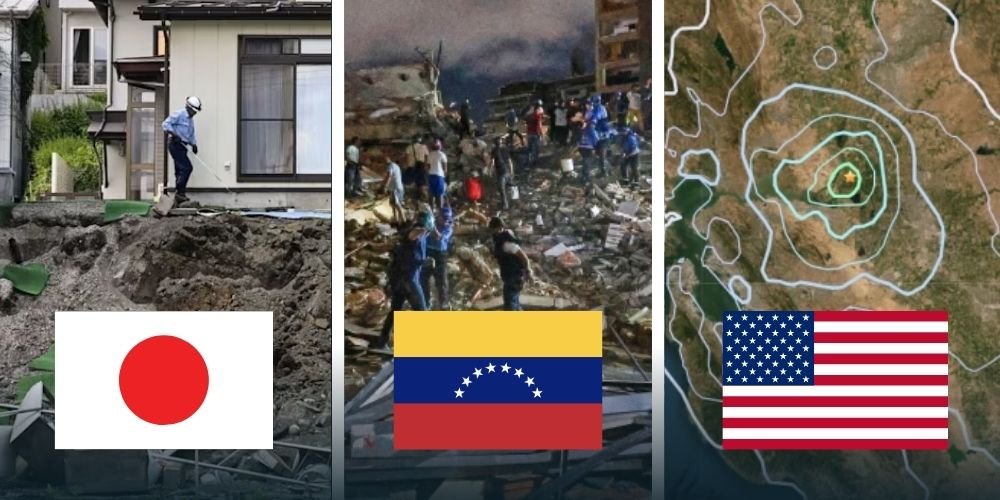
Four significant earthquakes struck the United States, Venezuela, and Japan within roughly eight hours, leaving Venezuela with the heaviest toll at around 235 dead and more than 4,300 injured. Northern California reported no deaths but recorded injuries, power outages, and localized damage, while Japan reported no deaths, eight injuries, minor damage, and temporary transport disruptions.
The close timing triggered emergency responses across three countries and renewed concern over communities living near active fault systems. Despite the sequence, seismologists said the earthquakes were not connected and occurred on separate regional fault systems thousands of kilometers apart.
The sequence began in Northern California, where a magnitude 5.6 earthquake struck near Redwood Valley and Willits in Mendocino County at 8:10 a.m. Pacific time on June 24. Officials reported no deaths, but hospitals recorded some injuries. More than 6,000 residents lost power in nearby towns, while local reports showed fallen merchandise, broken items, and localized damage. Authorities said there were no immediate reports of major structural damage.
Less than seven hours later, Venezuela was struck by a devastating earthquake doublet near its northern coast. USGS recorded a magnitude 7.2 quake followed 39 seconds later by a stronger magnitude 7.5 mainshock west of Caracas. Authorities reported around 235 deaths and more than 4,300 injuries as rescuers searched for people trapped under collapsed buildings.
The worst damage was reported in La Guaira, Caracas, Morón, and nearby communities. Reports said at least 250 buildings were damaged or destroyed, including hospitals, the Venezuelan Red Cross, and the French embassy. Thousands were left homeless, power and communications failed in some areas, and emergency crews worked through rubble as aftershocks continued. Acting President Delcy Rodríguez declared a state of emergency and appealed for calm.
About 25 minutes after the stronger Venezuela quake, a powerful offshore earthquake struck northern Japan near Iwate Prefecture. Japan’s meteorological agency upgraded the quake to magnitude 7.2, while USGS measured it at 6.9. No deaths were reported and officials said there was no tsunami threat. Eight people were injured in Aomori and Iwate, mostly from falling objects. A wall and a supermarket door were damaged in Hachinohe, train services were temporarily suspended for safety checks, and nuclear facilities reported no abnormalities.
U.S. Geological Survey (USGS) geophysicist William Barnhart described the timing as coincidence, noting that the earthquakes occurred on separate fault systems. Northern California is tied to the broader San Andreas fault system, Japan sits along the Pacific Ring of Fire, and northern Venezuela lies near the boundary between the Caribbean and South American plates.
For the Philippines, the global sequence comes weeks after the June 8 magnitude 7.8 earthquake off Maasim, Sarangani. The latest NDRRMC report placed the toll at 81 dead, 1,315 injured, and 31 missing, with more than 1.6 million people affected. The quake damaged 87,058 houses, destroyed 15,429 homes, and caused ₱1.356 billion in infrastructure damage across affected regions.