

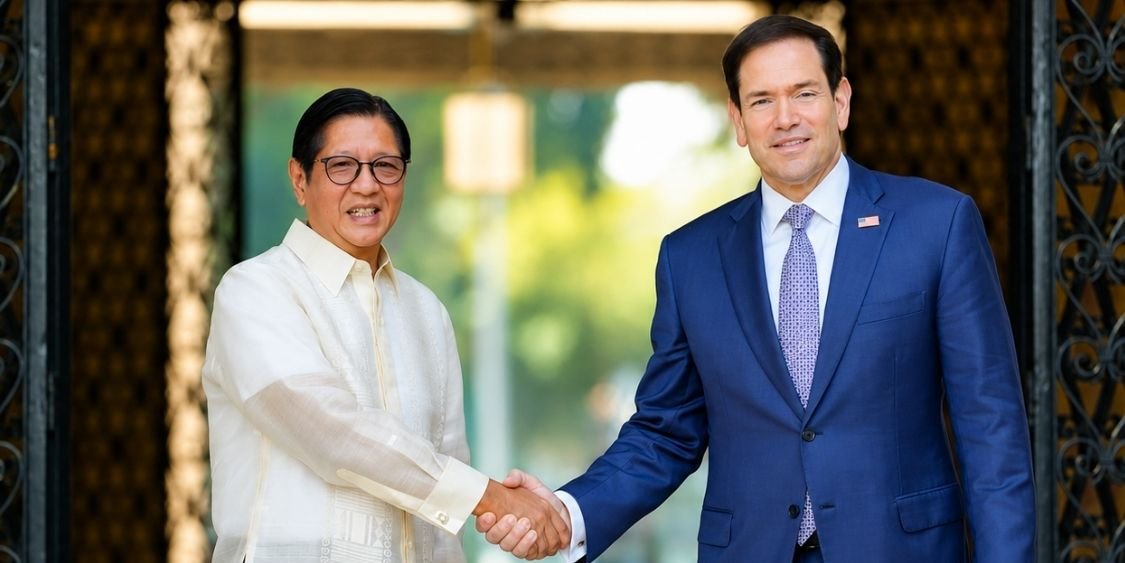
President Bongbong Marcos hosted U.S. Secretary of State Marco Rubio in Malacañang on July 22 for talks on strengthening bilateral cooperation in defense, technology, trade and regional security as the Philippines and the United States marked key milestones in their longstanding alliance.
Marcos welcomed Rubio during the latter’s first visit to the Philippines as US secretary of state. Rubio was in Manila to attend the ASEAN Foreign Ministers’ Meetings and Related Meetings.
Their discussions covered defense and security, artificial intelligence, energy and food security, trade, disaster response and stability in the Indo-Pacific. Marcos also thanked Rubio for US support in addressing challenges in the West Philippine Sea.
“This is a country that has deep ties with the United States for many, many years. And it’s a partnership that is only growing. And in light of recent events, I think more important than ever,” Rubio said.
Rubio’s visit also drew attention as his national profile continues to rise ahead of the 2028 U.S. presidential election. A May 2026 Emerson College poll showed him at 35%, one point behind Vice President JD Vance and up from 20% in February, strengthening his position as an early Republican presidential contender.
The meeting coincided with the 80th anniversary of diplomatic relations between the Philippines and the US and the 75th anniversary of the Mutual Defense Treaty. The two countries established diplomatic ties on July 4, 1946, and the United States remains the Philippines’ only treaty ally.
According to the Presidential Communications Office, the United States was the Philippines’ third-largest trading partner in 2025, its biggest export market and fifth-largest source of imports. Preliminary Bangko Sentral ng Pilipinas data also showed net US foreign direct investment reaching $183.99 million in 2025, while the United States was the country’s largest source of official development assistance grants in 2023 at $615.97 million.
Marcos said the Philippines and the US could continue expanding cooperation in promoting peace and stability in the Indo-Pacific, boosting trade and strengthening disaster response.