

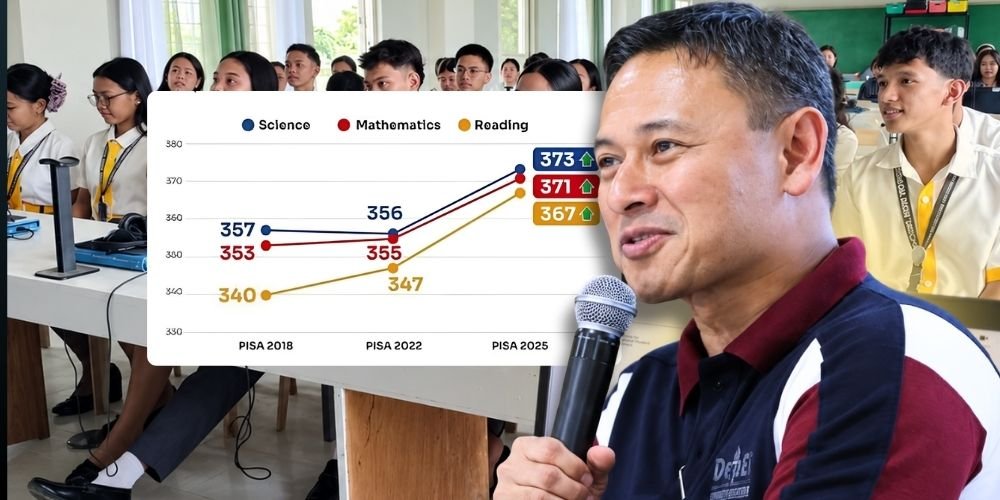
After two previous PISA cycles, the Philippines recorded its strongest performance yet across all three core subjects in 2025. Scores reached 367 in reading, 371 in mathematics and 373 in science, all above the country’s 2022 results.
The Programme for International Student Assessment (PISA) measures how well 15-year-olds apply what they have learned to real-world challenges. Its significance goes beyond a national examination: the Organisation for Economic Co-operation and Development (OECD) administers PISA under a common international framework, allowing education systems to measure student performance against the same benchmark. A Philippine improvement under PISA therefore carries international weight, providing an independent and comparable measure of how Filipino learners are progressing.
Education Secretary Sonny Angara presented the results for the DepEd (DepEd), with the 2025 gains arriving as the department sharpened its focus on foundational learning, remediation and learning recovery under his leadership. DepEd reported that the country moved out of the bottom 10 across reading, mathematics and science, adding an international result to the learning priorities Angara has pushed during his tenure.
“No country has improved its reading skills faster than the Philippines,” OECD Director for Education and Skills Andreas Schleicher said.
Official OECD data show reading climbed 20 points from 2022, alongside a 16-point increase in mathematics and a 17-point rise in science. The Philippines posted those gains during a PISA cycle when OECD-average performance declined in reading and mathematics.
“This tells us, may ginagawang tama ang Marcos administration sa kanyang education policy. Supported very much by our partners in Congress,” Angara said.
Angara said DepEd studied the weaknesses exposed by earlier PISA cycles and responded by strengthening basic reading, writing and arithmetic. He cited curriculum changes, remediation and improved computer access among the measures pursued by the department.
The Philippine assessment covered 8,072 students from 208 schools, representing about 1.75 million 15-year-olds. The OECD reported that Philippine data met PISA’s technical quality standards and were fit for reporting, reinforcing the results as a nationally representative measure of student performance.
The achievement also extended beyond higher averages. More Filipino students reached PISA’s baseline proficiency threshold in every core subject, with 31% reaching at least Level 2 in reading, 21% in mathematics and 32% in science. Together with record national scores, the results give DepEd an internationally comparable measure of the progress recorded in Philippine basic education.