


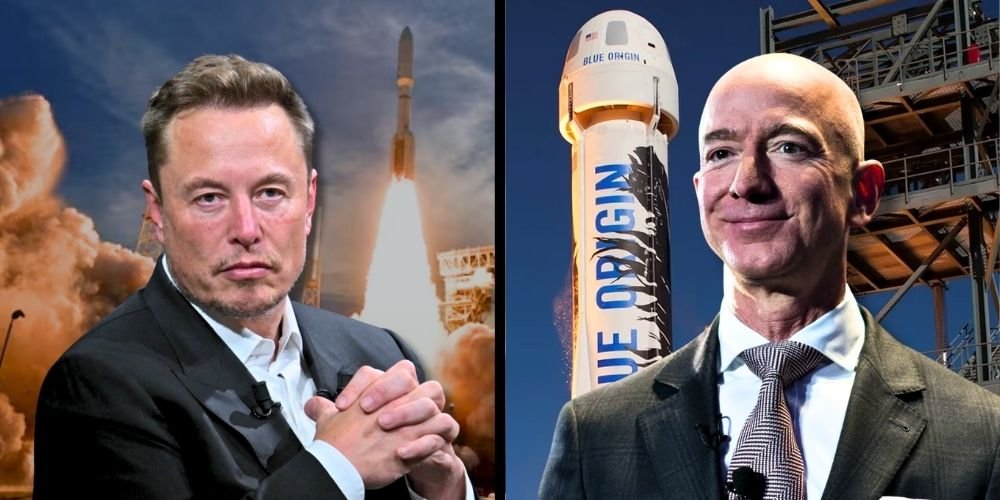
Two of the world’s most powerful billionaires are now racing beyond Earth, with the next moon landing at stake. NASA has positioned SpaceX and Blue Origin in a direct competition to develop the lunar lander that will carry astronauts to the moon in 2028.
The agency revised its Artemis timeline, turning the 2027 Artemis III mission into a full-scale test instead of a landing. This shift allows both companies to prove their systems before NASA selects a final provider.
NASA will use Artemis III to evaluate critical landing technologies in orbit. The Orion capsule will dock with each lander, while teams assess propulsion, communication, and life support systems. These tests will determine whether each spacecraft can safely support human missions to the lunar surface and back.
Elon Musk’s SpaceX enters with its Starship Human Landing System, developed under a $2.89 billion NASA contract. The vehicle is designed for vertical landings and large cargo capacity, but repeated test failures and delays remain a concern. While recent launches showed progress, the system has not yet reached stable orbit.
Jeff Bezos’ Blue Origin, meanwhile, is advancing its Blue Origin lander under a $3.4 billion NASA contract, supported by additional company funding. The design carries four astronauts and follows a more traditional approach using hydrogen and oxygen fuel. Recent thermal vacuum tests and a planned uncrewed mission mark key steps toward readiness.
“They both look at this as a competition, and that’s a great thing,” NASA Administrator Jared Isaacman said on how rivalry is expected to accelerate development ahead of future missions.
NASA will select the lander that performs best or is ready in time for Artemis IV in 2028. The agency may assign a later mission to the second provider to maintain progress. Long-term plans focus on building a sustained human presence near the moon’s south pole, where water and resources could support future missions.