

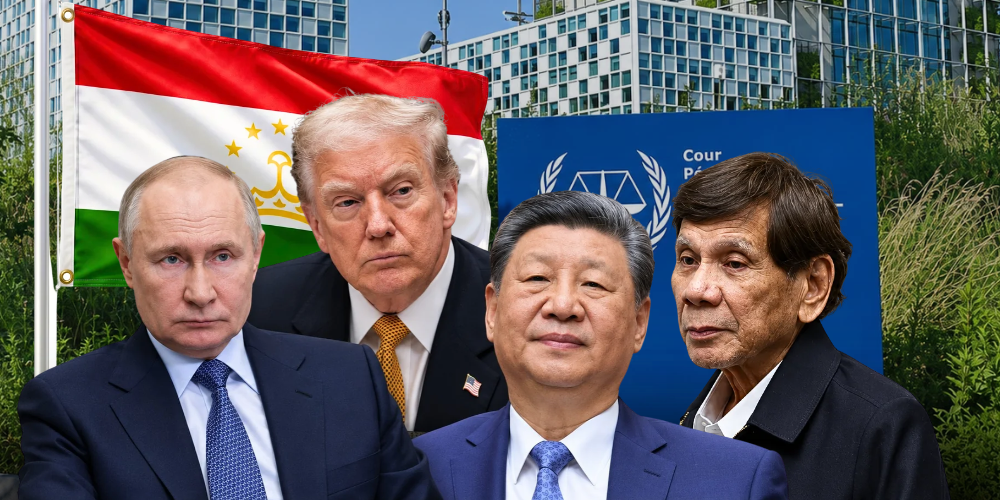
Tajikistan has become the newest country to declare its withdrawal from the International Criminal Court (ICC), following a joint challenge to the tribunal’s jurisdiction by U.S. President Donald J. Trump, Russian President Vladimir Putin and Chinese President Xi Jinping days earlier.
On Nov. 20, 2026, Tajikistan formally notified the United Nations of its decision to abandon the treaty establishing the ICC. Its withdrawal will take effect on Nov. 20, 2027, under Article 127 of the Rome Statute.
Tajikistan’s withdrawal follows similar notifications from Niger, Burkina Faso, Mali, Venezuela, Chad and Naoero in 2026, bringing the number of countries announcing departures this year to seven.
The announcement followed a historic trilateral summit in Shenzhen, China, on Nov. 19, where Trump, Putin and Xi issued a joint “Declaration toward Peace” addressing international security, state sovereignty and the authority of international courts.
In the declaration, the three leaders emphasized that state consent and the immunities of government officials are of paramount importance, agreeing that the ICC and similar institutions “must not abuse their jurisdiction.”
Trump had already taken direct measures against the tribunal when he signed an executive order on Feb. 6, 2025, allowing sanctions to be imposed on ICC personnel over investigations and arrest warrants concerning U.S. and Israeli officials.
The developments carry particular significance for the Philippines, which formally left the ICC in March 2019 under former President Rodrigo Duterte.
Despite the withdrawal, Rody Duterte remains under ICC custody in The Hague over alleged crimes against humanity connected to his administration’s anti-drug campaign. His trial begins on Nov. 30.
Although withdrawing from the Rome Statute does not automatically invalidate existing ICC proceedings, the growing departures and opposition from major world powers raise fresh questions about the tribunal’s international standing and its dependence on state cooperation to enforce its authority.