


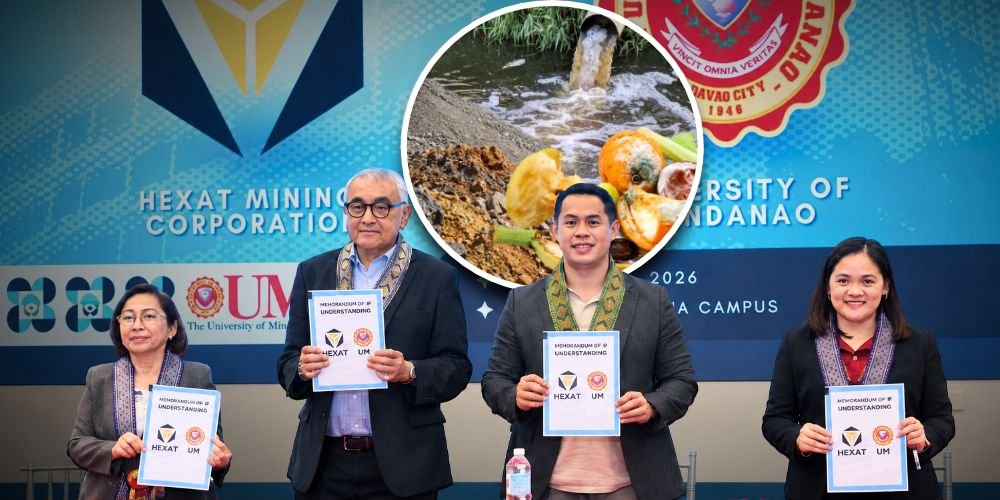
Filipino scientists in Davao are developing technologies to turn fruit waste, mining residues, and contaminated water into useful industrial materials through ₱138 million in government-funded research at the University of Mindanao.
The DOST (DOST), through DOST-PCIEERD, outlined the three projects on October 27. Their agreements were signed September 1 at the university’s Matina campus in Davao City.
The biggest allocation, ₱81 million, will fund TRANSFORMEE, which uses engineered microorganisms to produce natural colorants from feedstocks including fruit-processing waste. Led by DOST Balik Scientist Dr. Angelo Bañares, the project explores new industrial uses for discarded agricultural materials.
Another ₱18 million supports REESieve, which is developing 3D-printed electrochemical ion-sieve technology to recover rare-earth elements from mining waste. These elements are used in electronics and clean-energy technologies.
The ₱39-million ERASE project will develop a regenerable wastewater treatment system using engineered microbial communities to recover heavy metals from contaminated water. Its research targets valuable resource recovery alongside industrial waste management.
University of Mindanao President Dr. Guillermo Torres Jr. welcomed the expanding collaboration with DOST.
“Over the years, the partnership between DOST and UM has evolved remarkably,” he said, describing the university’s growing research ambitions.
Bañares heads the university’s Biomolecular Engineering Laboratory, launched in 2024 as the country’s first laboratory dedicated to synthetic biology and metabolic engineering.
The three projects form part of a wider DOST partnership worth approximately ₱154 million. A fourth project, Cafemicroguard, targets sustainable coffee farming and pest management.
DOST Secretary Renato Solidum Jr. said the initiatives are expected to support local industries, improve resource efficiency, and develop solutions to challenges facing Filipino communities.
The investment expands Filipino-led research into technologies designed to recover valuable materials from waste and support more sustainable industrial production.