

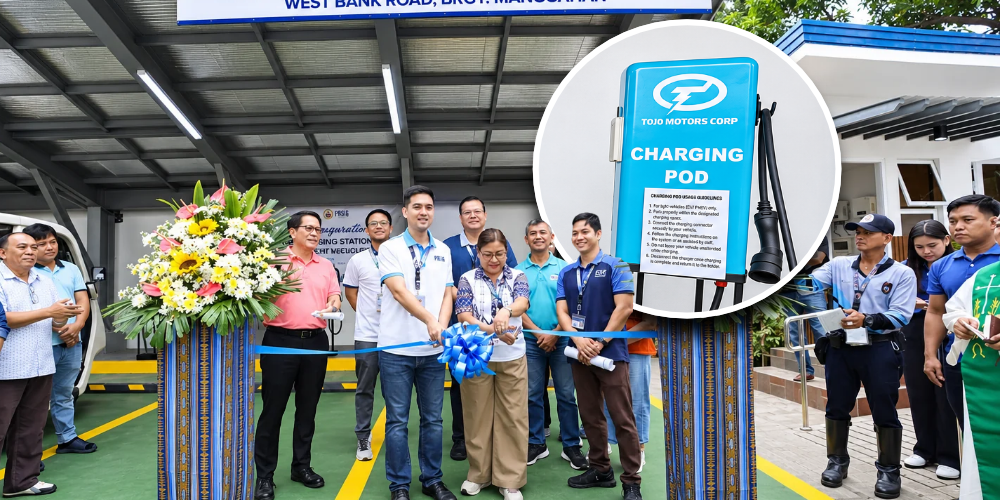
Pasig City Mayor Vico Sotto has opened a new public electric vehicle charging station in Barangay Manggahan, giving motorists access to free charging as the city expands its push for cleaner and more accessible transport.
The facility, located near the Pasig EcoHub along West Bank Road, covers about 318 square meters and is open to the public 24 hours a day. Charging is available on a first-come, first-served basis, although city buses and other local government electric vehicles are given priority.
“New electric vehicle charging station in Pasig (Manggahan). For now, it is open to the public and may be used for FREE,” Sotto said.
The station has four AC charging pods that can serve e-bikes, e-scooters, electric motorcycles, electric cars and larger electric vehicles.
Sotto said the entire project cost around ₱4 million, covering the charging facility, pavement and public restrooms.
“The whole project cost around P4 million, including the bathrooms, pavement, and, of course, the station itself,” he said.
The station uses electricity from the power grid with support from inverter solar panels. It also includes an electrical room, public restrooms and a rainwater collection system capable of storing up to 1,000 liters.
The project follows Pasig’s recent opening of the redeveloped Ilaya Buting Linear Park, the city’s third linear park. The facility includes playground and exercise equipment, a basketball court, public comfort rooms and lighting, expanding the city’s limited supply of open and green spaces. Sotto said Pasig needs more places where children, senior citizens and families can safely gather.
Pasig has also gained international recognition for its push to create more public spaces. The city was named one of 24 global winners of the Bloomberg Philanthropies 2025–2026 Mayors Challenge for its proposed floating parks project along the Pasig River. Selected from more than 630 applications worldwide, Pasig received a $1 million grant, technical assistance and implementation support for the project.
The EV charging station adds another layer to that broader city agenda, combining transport infrastructure, renewable energy support and free public access.