

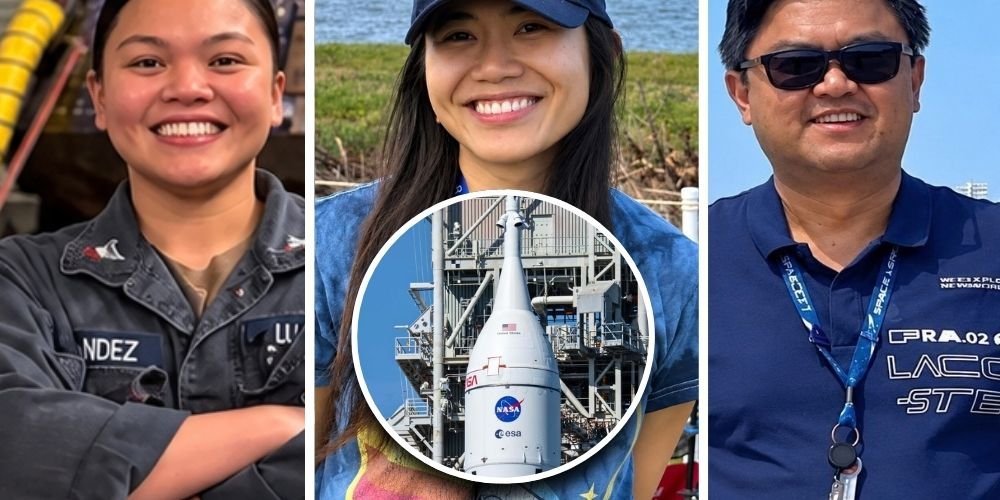
Three Cebuanos helped carry NASA’s Artemis II through key stages, linking Cebu to humanity’s first crewed journey around the Moon in more than half a century. From safeguarding Orion before flight and certifying the systems that powered it through deep space to supporting the recovery operation that brought its crew home, their work placed Cebuano talent inside a mission that reopened the era of crewed lunar exploration.
Artemis II launched from NASA’s Kennedy Space Center on April 1 and splashed down in the Pacific on April 10 after carrying Reid Wiseman, Victor Glover, Christina Koch and Canadian astronaut Jeremy Hansen around the Moon aboard Orion. It was the first crewed flight of NASA’s Artemis program and the first time humans had traveled to the Moon’s vicinity since Apollo.
Arianne “Nikki” Jubay Lazaro, whose family is from Balamban, Cebu, served as a senior materials engineer on the Orion Fracture Control Team. Her work focused on the integrity of critical spacecraft components, including systems tied to environmental control and life support.
Jay Bustamante served as a Lead Systems Engineer at Lockheed Martin, Orion’s prime contractor, and was responsible for certifying the spacecraft’s service module for flight. The module provides propulsion, electrical power, thermal control and life-support resources. His path began in Cebu, where he studied at Don Bosco Technical High School, CITE Technical Institute and Cebu Institute of Technology–University.
Cebu’s connection reached the final stage through Armila Reyna Fernandez of Dumanjug, who served as an Engineman Second Class aboard the USS John P. Murtha, the U.S. Navy ship involved in recovering Orion and its crew after splashdown.
Lazaro, Bustamante and Fernandez never worked as one team, but their roles traced a single Cebuano thread through Artemis II. One helped protect Orion from structural failure, another helped certify the systems that sustained its voyage, and another served aboard the ship waiting at the end.
As Artemis moves toward future missions aimed at returning astronauts to the lunar surface, three Cebuanos have already secured a place in this new chapter of human exploration.