

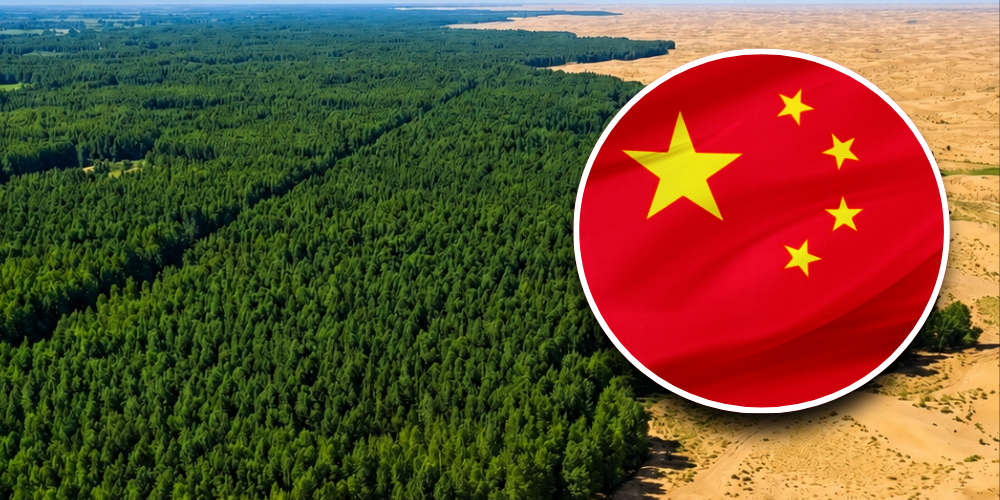
China has spent decades transforming degraded landscapes into greener areas through one of the world’s largest reforestation campaigns, planting billions of trees to fight desertification, restore ecosystems and protect vulnerable regions from environmental threats.
At the center of the effort is the Three-North Shelterbelt Forest Program, also known as the “Great Green Wall,” launched in 1978 to create a massive forest barrier across northern China. The project spans parts of northwest, north and northeast China, aiming to slow desert expansion, reduce sandstorms, protect farmland and restore damaged land.
Since its launch, the program has transformed millions of hectares. China reported that more than 46 million hectares of forest have been planted in the Three-North region, while forest coverage in areas covered by the project has increased significantly compared with previous decades.
The reforestation campaign continues to expand. In 2024 alone, China planted 4.45 million hectares of trees and improved millions of hectares of grassland as part of its broader national greening efforts. The government also reported that forest coverage has exceeded 25 percent, with planted forests among the largest in the world.
China’s forestry authorities said the Three-North program serves as an ecological barrier against desertification while improving environmental conditions in regions vulnerable to land degradation.
Beyond slowing desert expansion, the campaign has reshaped landscapes once known for harsh conditions. Scientists have studied how planted forests under the Great Green Wall have affected local ecosystems as restoration efforts continue.
China has also promoted nationwide participation in tree planting, turning reforestation into a public environmental campaign. Official figures show that billions of trees have been planted through voluntary programs involving millions of citizens over several decades.
The decades-long effort remains one of the largest examples of human-led environmental restoration, showing how large-scale conservation projects can reshape landscapes and combat climate challenges.