


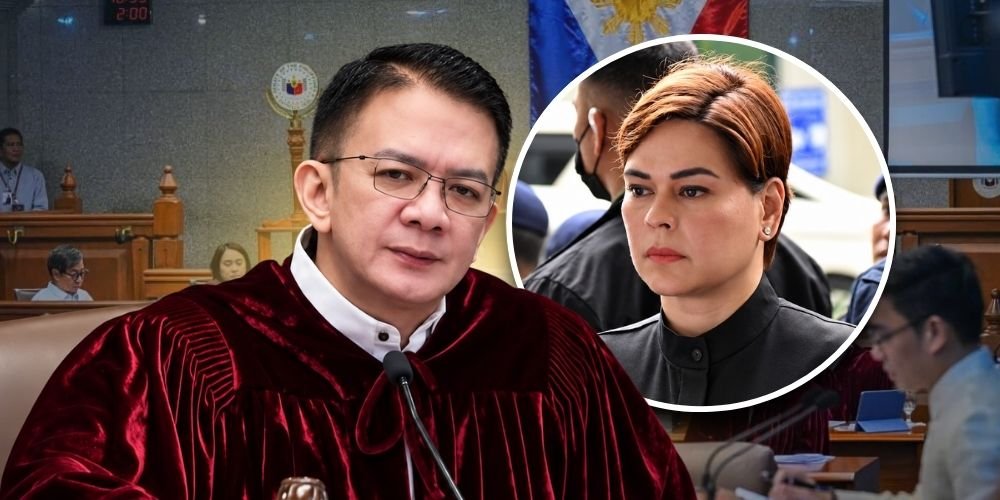
Senate Impeachment Court Presiding Officer Chiz Escudero defended his lone dissent against changing the conviction threshold in the impeachment trial of Vice President Sara Duterte, maintaining that the requirement should remain at 16 votes from the 24-member Senate based on his interpretation of the Constitution.
Escudero voted against reversing his July 6 ruling that set the conviction requirement at two-thirds of the entire Senate membership. Four senator-judges were absent during the proceedings when the court revisited the threshold.
The move to reconsider the rule was triggered by a motion from Senator Erwin Tulfo. Thirteen senators voted in favor of revisiting the threshold, while six members of the minority bloc did not participate after refusing to return to the session hall.
Escudero said his dissent was anchored on Article XI, Section 3(6) of the 1987 Constitution, which states that conviction in an impeachment trial requires the concurrence of two-thirds of all members of the Senate.
“The Chair stands by his July 6 ruling. Article XI, Section 3(6) of the Constitution must be given its plain and literal meaning. The Chair finds no basis in the constitutional text for interpreting it otherwise,” Escudero said.
He argued that the Constitution’s use of the phrase “all the Members of the Senate” should be interpreted based on the full composition of the chamber, rather than the number of senators participating in the proceedings.
Escudero also cited the omission of the word “present” from the Philippine Constitution’s impeachment provision, arguing that the term was deliberately excluded and cannot be added through interpretation.
“The word ‘present’ was intentionally omitted and has remained absent from our Constitution ever since. What the Constitution has omitted, for me, cannot now be restored by interpretation,” he said.
The Senate president further argued that changing the basis for computation could create fluctuating conviction requirements depending on the number of participating senator-judges.
“The conviction threshold falls 13 times, while the acquittal threshold falls only seven times. In other words, a variable denominator makes it easier to secure a judgement of conviction compared to a judgement of acquittal,” Escudero said.
Escudero also invoked the principle of in dubio pro reo, saying constitutional doubts should not be used to make it easier to remove an elected official from office.
“Terminating an elected mandate before the end of its term is among the most drastic acts our constitutional democracy can undertake. Therefore, when the Constitution fixes the conditions and number for imposing a judgment of conviction, those conditions should not be relaxed by implication, nor should the number rise or fall according to the contingencies of the day,” he said.
The impeachment court later adopted a new interpretation allowing the conviction threshold to be computed based on senator-judges who are legally and factually qualified to participate in the proceedings. Escudero continued to preside over the trial despite his dissent, while noting that the ruling would apply only to the current case.