

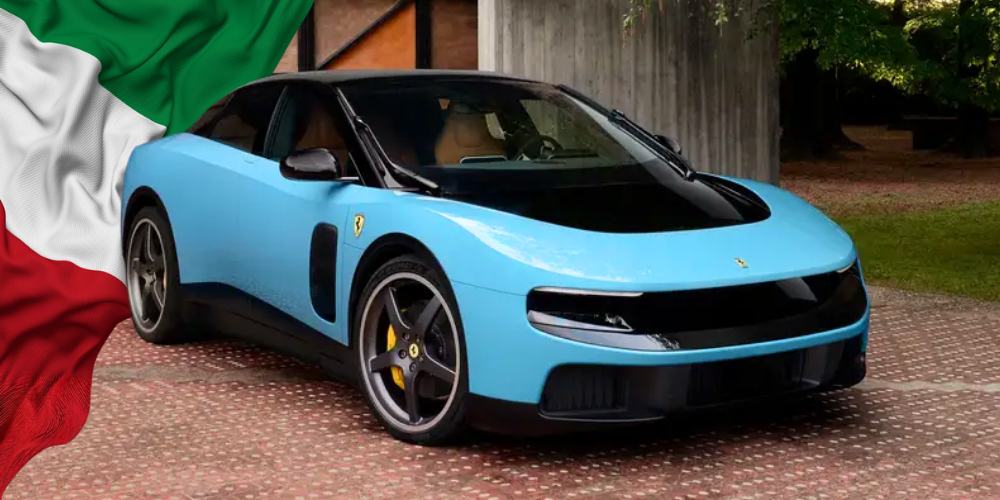
Ferrari unveiled the Luce, its first fully electric vehicle and first-ever five-seater, at a launch event in Rome on Monday, May 25, 2026, ending years of speculation about whether the Italian sports-car maker would commit to an EV product line. The four-door starts at €550,000 — about US$640,000, or roughly ₱39.4 million at Tuesday’s ₱61.57-per-dollar market rate — with first European deliveries due in the fourth quarter of 2026 and US deliveries from the 2027 model year.
The Luce is powered by four electric motors, one per wheel, producing a Ferrari-stated peak output of 1,050 horsepower and accelerating from 0 to 100 kilometers per hour in roughly 2.5 seconds. Top speed exceeds 310 km/h. A 122-kilowatt-hour battery on an 800-volt architecture supports DC fast charging up to 350 kilowatts, and WLTP-rated range reaches up to 530 kilometers.
Ferrari entrusted the Luce’s design to LoveFrom, the firm led by Sir Jony Ive — the former Apple chief design officer behind the iPhone and iMac — and industrial designer Marc Newson. “This has been probably one of the most exciting projects that we ever developed in Ferrari,” Chief Executive Officer Benedetto Vigna said at the unveiling at Rome’s Vela di Calatrava-Città dello Sport complex. “This is going to be the most versatile Ferrari ever produced.”
Investors disagreed. Ferrari shares fell as much as 7.8 percent in Milan on Tuesday — the steepest one-day drop since October — before paring losses to about 6.5 percent; the dual-listed Ferrari N.V. (NYSE: RACE) shed roughly 4.6 percent in New York. Former Ferrari chairman Luca Cordero di Montezemolo, who led Maranello for more than two decades through its modern golden era, said publicly he hopes “someone removes the Prancing Horse from that car,” warning the model risks “destroying a legend.” Analysts Anthony Dick of Oddo BHF and Pierre-Olivier Essig of AIR Capital separately characterised the design reception as the sharpest negative reaction to a car launch in memory.
The contrarian bet matters for the broader luxury-EV market. Porsche and Lamborghini have scaled back EV product roadmaps over the past year, citing slower-than-expected adoption and high battery costs. Ferrari is wagering that wealthy buyers want a usable second EV alongside their petrol Ferraris — and that the Jony Ive design pedigree will carry the brand-cultural risk.
The next test arrives when European deliveries begin in the fourth quarter.