


For decades, the Philippines has relied on foreign launch providers to send satellites into space. Now, Filipino engineers are building expertise that could bring the country closer to developing and launching space systems from its own soil.
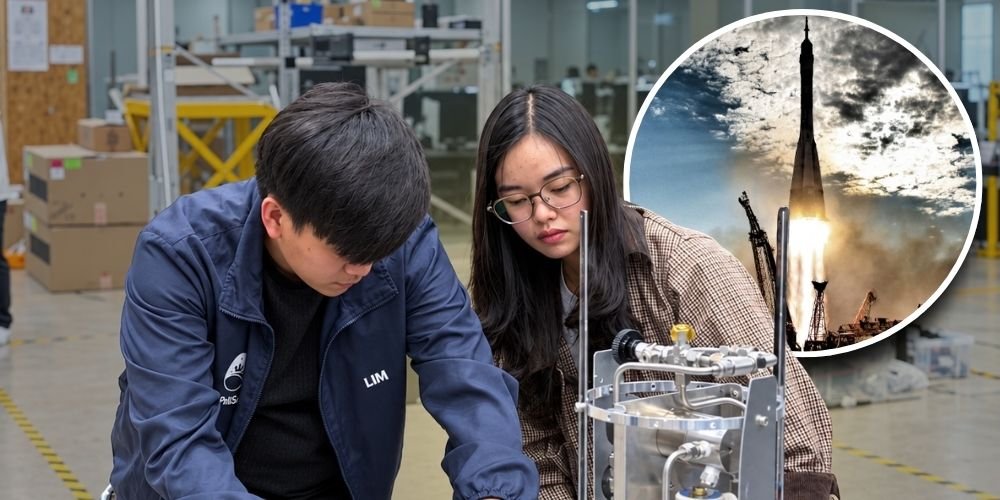
A 10-member Philippine Space Agency (PhilSA) team is in South Korea assembling and testing a liquid-fueled sounding rocket planned for a 2027 launch in Lal-lo, Cagayan under the SIKLAB: Building Industrial Space Launch Systems Project.
The training with South Korean space mobility company Perigee covers rocket assembly, system integration, testing, safety procedures, and launch operations. Afterward, the rocket assembled by the Filipino team will be shipped home for further testing before its planned flight.
The goal reaches beyond launching a rocket. PhilSA Acting Director General Gay Jane P. Perez said developing domestic launch capabilities could give the Philippines greater flexibility and independence in sending satellites into space, with applications in security, telecommunications, and agriculture.
That capability could make space technology more useful to problems on the ground. The 2027 mission, for example, will carry a locally developed two-kilogram payload to an altitude of at least five kilometers to detect and monitor radio signals from sources such as 4G LTE cell towers.
Data gathered by the technology could eventually help identify communities with limited cellular coverage. More broadly, PhilSA sees greater domestic space capability supporting services Filipinos increasingly depend on, while reducing reliance on foreign launch providers for access to space.
The mission will also test whether the Philippines has developed the technical, operational, safety, and regulatory foundations needed to conduct future launches locally.
“A successful liquid-fueled sounding rocket test launch in 2027 will demonstrate that we have the technical, operational, safety, and regulatory foundations for future launches from the Philippines; and potentially attract foreign investments from private aerospace companies,” Perez said.
That creates another potential benefit: jobs and industries. PhilSA describes SIKLAB as a long-term investment in Filipino talent, aimed at building an ecosystem where scientists, engineers, business and support professionals can pursue high-value space-sector careers without having to leave the country.
PhilSA and the Cagayan Economic Zone Authority are preparing the launch site, coordinating with local governments and communities, and developing a safety exclusion zone plan. Existing infrastructure, including Cagayan North International Airport, could support the area’s development as a gateway for Philippine space activities.
If successful, the 2027 mission would therefore test more than a rocket. It would test whether the Philippines can begin turning Filipino engineering talent into a domestic space capability that supports connectivity, agriculture and security, attracts aerospace investment, and creates high-value careers at home.