


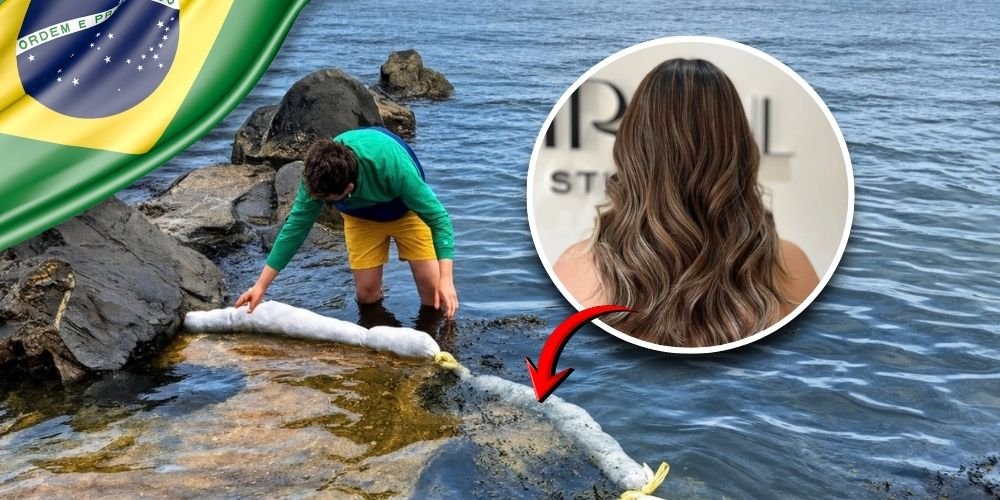
Hair swept from salon floors is being put to work against oil pollution in Brazil, where discarded human strands are helping trap petroleum and other oily contaminants before they can spread deeper into Rio de Janeiro’s Guanabara Bay.
At the Bom Jesus inlet on Ilha do Fundão, cylindrical filters packed with human hair have been attached to an existing floating barrier roughly 300 meters long. The structure already intercepted solid waste. The added hair filters allow it to catch oily pollutants moving across the water and strengthen protection for a nearby mangrove ecosystem.
The system takes advantage of hair’s ability to attract and retain oil. Fiotrar founder Mariana Robrahn said the material can hold several times its own weight in petroleum.
“Each gram of hair has the potential to absorb five grams of oil, and that is precisely the work of the barrier,” Robrahn said.
The strands are packed into cotton mesh to form long, sausage-shaped filters that remain at the water’s surface, where floating oil can encounter them. Environmental engineer Ana Beatriz Gonçalves, who oversees weekly maintenance of the barriers, said the hair filters use the existing floating trash barrier as their support.
“The idea is the oil that flows here be absorbed by that hair barrier so they are attached to the orange rubbish barrier, which floats, and we use it as support for the Fiotrar barrier,” Gonçalves said.
Fiotrar collects hair that would otherwise be discarded, including clippings from participating salons. By August, about 10 salons were contributing material to the project. Hair that has little or no value after cutting can instead be packed into filters and used to intercept pollution.
The technology was installed at the Bom Jesus inlet in March after about a year of testing to adapt the system to conditions in Guanabara Bay. Fiotrar and Orla Sem Lixo Transforma carried out the project with support from Fundação Grupo Boticário. The installation marked the first application of the technology in a natural environment in Brazil.
Fiotrar director Caroline Carvalho described the installation as the result of years spent developing the idea into a working environmental tool.
“After a long journey to transform an idea into an applicable solution, reaching this stage means proving, in practice, that it is possible to unite science, sustainability and social impact in a concrete way,” Carvalho said.
The filters can remain in the water for months while collecting oil and other pollutants linked to vessel activity, illegal discharges and other sources. Guanabara Bay has long faced pollution pressure from dense urban development, industrial activity and heavy maritime traffic.
For fishing communities, oil on the surface can quickly affect daily work. Local fisherman Sérgio Carvalho said contamination can spread beyond the visible slick.
“When we go out to fish with nets, we come across many oil spills that harm our work. The oil stays on the surface but affects everything down to about a metre and a half in depth. The fish disappear,” Carvalho said.
The hair barriers give an abundant waste material a practical second use. Clippings once swept up and thrown away are being packed into filters capable of holding oil at the surface, reducing the amount that can move farther into mangroves and fishing areas.