


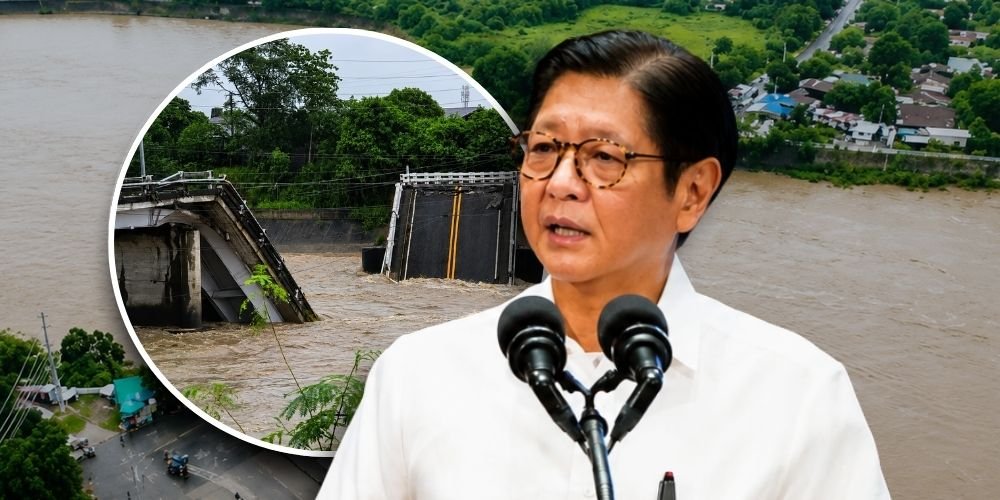
President Bongbong Marcos announced ₱300 million in national government assistance for the rehabilitation of Tarlac City’s damaged Agana Bridge, where an SUV carrying five people plunged into floodwaters after the structure collapsed, leaving one survivor and four initially missing, two of whom have since been found more than 100 kilometers away in Dagupan, Pangasinan.
Marcos made the announcement during his inspection of the damaged bridge, where he said climate change has contributed to unprecedented rainfall that has caused severe damage to bridges.
“We will be giving P300M to the local government dahil ito ay local bridge. Kaya sila ang kailangan magkatrabaho dito. Siyempre, tutulungan natin sa technical aspects that will help them in every way that we can,” Marcos said.
The President said repairs are being fast-tracked, with a Bailey Bridge expected to accommodate pedestrians within a week and light vehicles within two weeks.
“Within 2 weeks siguro pwede nang mabuksan [ang Bailey Bridge] para makadaan ang sasakyan. Mga light vehicle lang siguro ang maaring tumawid, 10 tons below, not more than that,” Marcos said.
Marcos described the flooding that damaged Agana Bridge as unprecedented, saying the volume and force of the water surpassed anything previously experienced in the area. He noted that the bridge had stood for decades without major problems.
“Unprecedented kung gaano karami ang tubig. Ngayon lang tayo nakakita nito. This bridge has been standing since after the war. So, 70 years old na ito. Wala naman naging problema hanggang ngayon. Ito ang epekto ng climate change,” Marcos said.
He also pointed to increasingly intense weather events linked to changing climate patterns, citing damage to other infrastructure in Tarlac.
“Nanggaling din kami sa Aquino Bridge, natangay din yung section,” Marcos said.
He said the repairs need to move quickly as residents face limited access while the damaged bridges remain unusable.
Beyond the immediate repairs, Marcos ordered local governments to strictly enforce “no-build zones,” keep waterways clear, remove obstructions and improve waste disposal to help reduce flood risks.