

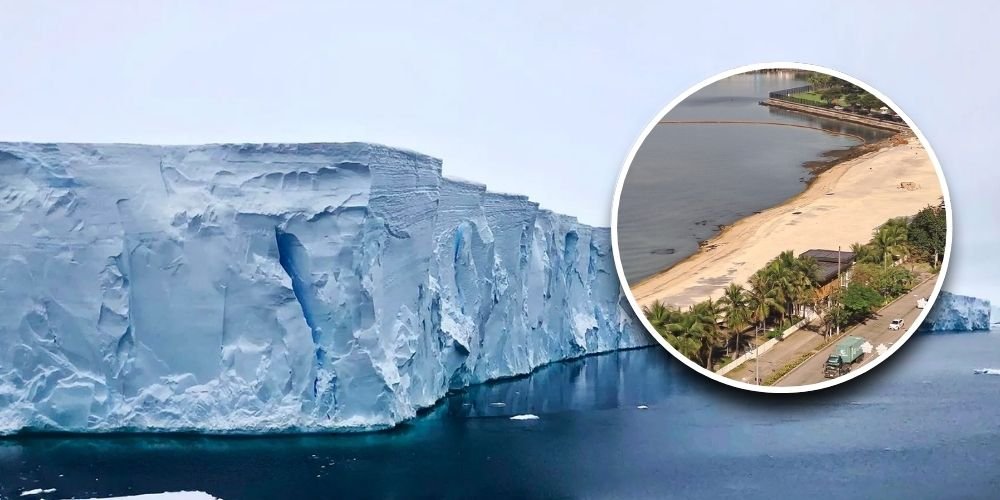
A new study suggests Antarctica’s Thwaites Glacier, often called the “doomsday glacier,” could contribute twice as much to global sea-level rise by 2100 as previous models estimated, heightening concerns for Philippine coastal areas already dealing with rising waters.
Published Oct. 12 in Nature Communications, the research from UC Irvine and NASA’s Jet Propulsion Laboratory projects up to 30 millimeters, or 1.2 inches, of global sea-level rise from Thwaites by 2100 even without additional climate warming. In the Philippines, the resulting rise could submerge significant portions of areas surrounding Manila Bay.
The researchers found warm seawater reaches several kilometers beneath the glacier with the tides, melting ice in areas older models overlooked. Using satellite measurements and records of glacier changes from 1996 to 2023, they developed a model that better captures how quickly Thwaites is retreating.
“Satellite observations demonstrate the existence of a ‘grounding zone,’ sometimes kilometers wide, where warm ocean water is reaching deep underneath the ice sheets and causing vigorous melting,” study lead author Mattia Poinelli said.
Thwaites already accounts for around 4% of annual global sea-level rise. It contains enough ice to raise seas by roughly 65 centimeters if it eventually melts entirely, a much longer-term scenario than the study’s 2100 projection.
The findings have consequences for the Philippines, where the National Mapping and Resource Information Authority reported that sea levels measured around Manila rose by an average of 8.4 millimeters annually from 1901 to 2022. The agency said sinking land also contributes to the local trend.
The Climate Change Commission has said more than 60% of Filipinos live in coastal areas. The country’s National Adaptation Plan identifies rising seas and extreme coastal water levels as threats to communities, infrastructure and livelihoods.
The study also projects a roughly 60% probability that Thwaites’ main section will lose contact with a stabilizing underwater ridge by 2100 in simulations using a four-to-six-kilometer grounding zone, potentially speeding up ice retreat.