

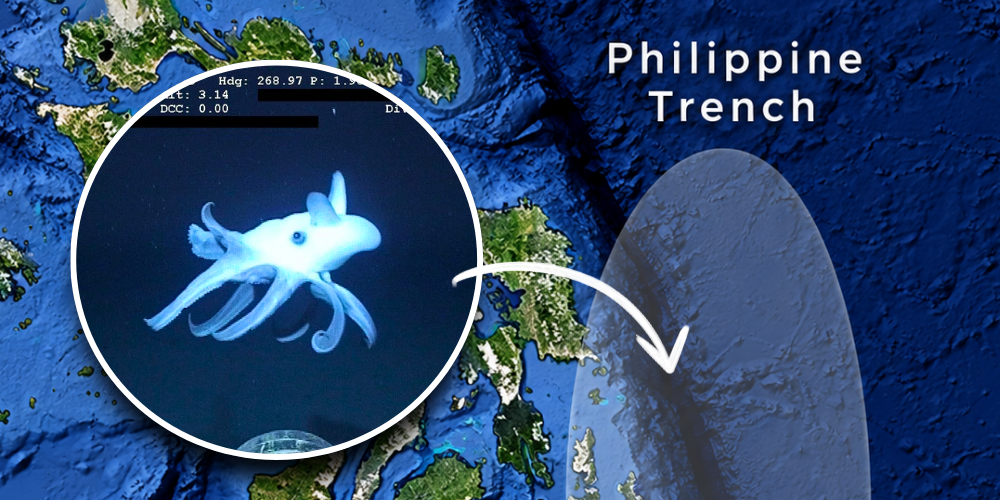
Located in the eastern Philippine Sea, the trench extends along the eastern side of the Philippine archipelago near Samar, Leyte, Surigao, and Mindanao. Stretching about 1,320 kilometres, it is among the deepest ocean trenches on Earth, with its deepest known point called the Emden Deep.
At these depths, sunlight cannot reach the seafloor. Temperatures remain near freezing, while pressure exceeds 1,000 times the pressure experienced at sea level. Despite these conditions, the Philippine Trench supports organisms that have adapted to survive in extreme environments, including amphipods, sea cucumbers, brittle stars, deep-sea fish, and microorganisms.
Because of its depth and harsh conditions, exploring the trench requires specialized equipment such as research vessels, remotely operated vehicles, and deep-sea submersibles. Scientists have explored only a small portion of the area, leaving many parts of its ecosystem and biodiversity still unknown.
On March 23, 2021, UP Marine Science Institute Associate Professor Deo Florence Onda became the first Filipino to reach the Emden Deep. Onda joined American explorer Victor Vescovo aboard the DSV Limiting Factor submersible during an expedition organized by Caladan Oceanic.
During the dive, Onda documented human waste at the bottom of the trench, including plastic bags and clothing. Reflecting on the discovery, Onda said,
“If in the beginning, I felt like I was on Mars, when I saw the garbage, I thought to myself, ‘Am I in Payatas?’”
The Philippine Trench continues to be studied for its geological importance and deep-sea biodiversity, offering scientists insights into extreme environments found beneath Philippine waters.