

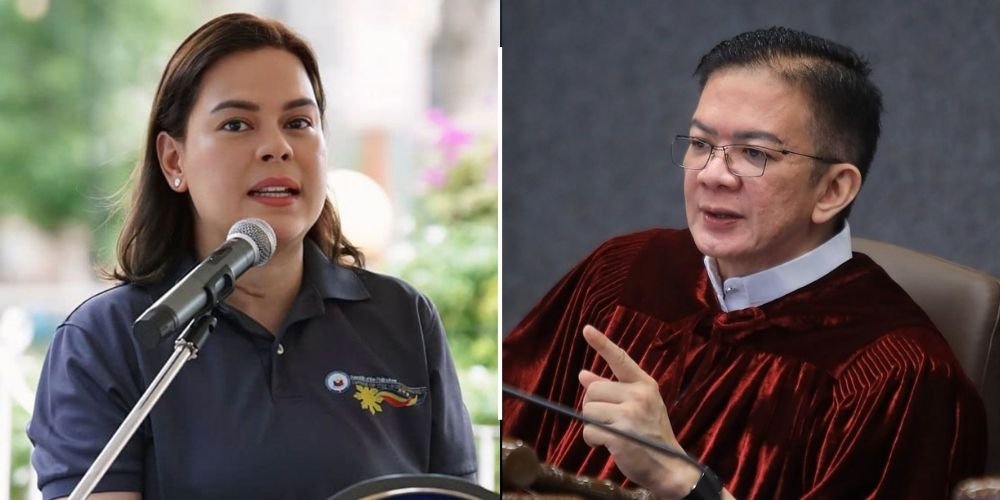
Vice President Sara Duterte’s defense team gained a significant procedural advantage on Wednesday after impeachment court Presiding Officer Sen. Chiz Escudero announced that tougher penalties would be imposed for future violations of the court’s rules governing public statements.
The ruling came about two weeks after lead defense counsel Sheila Sison formally raised the defense’s complaint before the impeachment court, drawing attention to statements being made outside the courtroom while the impeachment proceedings remained ongoing.
On the 19th day of the impeachment trial, Escudero said the court would show “grace” toward past conduct and “wipe the slate clean,” but made clear that the rule would be enforced more strictly from this point onward.
“With respect to prior statements or conduct covered by Rule 18, the Court shall extend grace, exercise liberality, and wipe the slate clean. Tabula rasa, so to speak,” Escudero said.
Escudero directed the prosecution, defense, respondent, lawyers, witnesses and other individuals covered by the rule to avoid publicly discussing the merits of the pending impeachment case. He also cautioned against “trial by publicity,” saying such conduct could threaten the independence and dignity of the impeachment court and risk replacing evidence with public outrage.
The court’s firmer approach followed a series of public remarks by members and representatives of both the prosecution and defense concerning the substance of the case.
Earlier this month, prosecution panel member Terry Ridon repeatedly described the confidential-funds issue as a “scam” and likened it to the Napoles PDAF controversy. This week, prosecution lawyer Mae Divinagracia defended the repeated use of the term “scam,” saying the prosecution wanted to “call a spade a spade.”
Although Escudero chose not to penalize past violations, he laid out a progressively tougher set of consequences for future breaches.
A person accused of violating the rule may be ordered to explain through a show cause order and given 24 hours to file a verified written response.
A first offense could result in a public reprimand, while a second violation could carry a fine of up to P30,000 for each offense. The same maximum fine could be imposed for subsequent violations. The court may also limit a violator’s ability to speak, object or question witnesses on the Senate floor.
For lawyers, records of violations could also be transmitted to the Office of the Bar Confidant, the Integrated Bar of the Philippines and/or the Supreme Court for possible disciplinary proceedings.