

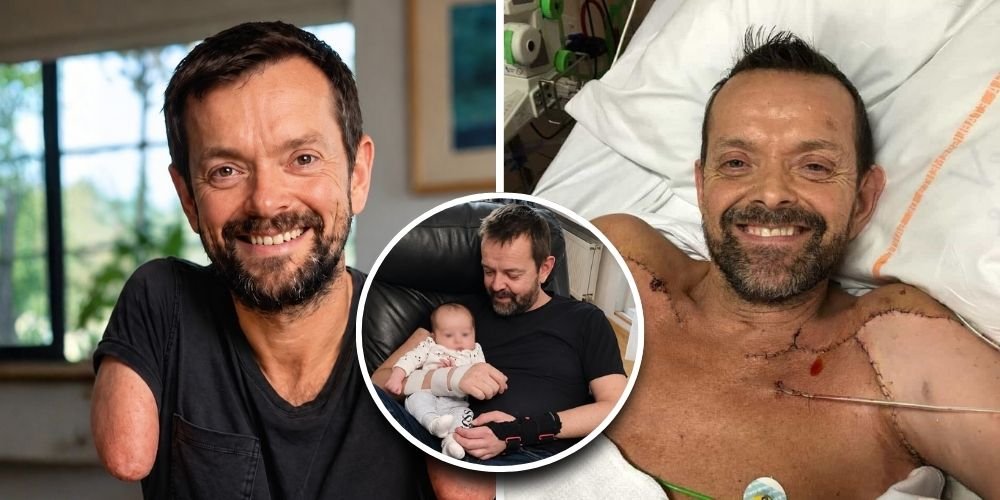
Guðmundur Felix Grétarsson spent 23 years without either arm before undergoing a world-first double arm transplant in France that eventually gave him enough mobility to embrace his family again.
The Icelandic electrician was 26 when he was hit by an 11,000-volt electrical shock while working on a high-voltage line on Jan. 12, 1998. The accident left him with extensive burns, multiple fractures and internal injuries. Following numerous surgeries and infections, doctors eventually amputated both arms at a high level. He remained in a coma for roughly three months.
Grétarsson received a liver transplant in July 2002 but needed another one the next month after developing portal thrombosis. The procedures meant he would need lifelong immunosuppressive drugs, years before doctors would consider him for an arm transplant.
On Jan. 13, 2021, surgeons at Hôpital Édouard-Herriot in Lyon carried out a bilateral arm transplant that also involved reconstructing his left shoulder. Hospices Civils de Lyon called the procedure a world first. The surgery lasted nearly 15 hours.
For his right arm, surgeons connected the donor humerus to the nine-centimeter portion of his upper arm that remained. On the left, they transplanted the donor’s entire humerus and reconstructed the shoulder joint. The operation also involved repairing about 15 muscles and tendons, two arteries, three veins and numerous nerves.
Rehabilitation began just 12 hours after surgery with passive physiotherapy. Months later, movement began returning as the nerves gradually regenerated into the transplanted arms. Two years after the operation, doctors recorded movement in his elbows, wrists and fingers, as well as the return of sensation.
By 2022, Grétarsson said he could brush his teeth, get dressed, eat using utensils, drink from a glass and take care of his personal hygiene. He had also regained the ability to hug his children and grandchildren. His daughters were four years old and just three months old when the 1998 accident happened.
The surgical team later detailed his recovery in a peer-reviewed study published in 2024, covering the first 24 months following the transplant.